
7
September, 2026
Data Center HVAC Design: Planning Cooling Capacity for Phased IT Growth
A data center may be designed for its ultimate IT capacity, but it rarely begins operating at that level.
This creates a difficult HVAC brief. The cooling system must perform efficiently at day-one demand, expand without disrupting live operations, and remain resilient as rack densities and technology requirements change.
Getting the final capacity right is only one part of the decision. The path to that capacity matters just as much.
The Cooling Load Is Moving Faster Than the Building Program
The International Energy Agency expects global data center electricity consumption to rise from approximately 485 TWh in 2025 to 950 TWh by 2030. Electricity use by AI-focused facilities is projected to triple over the same period.
For individual developments, rapid demand growth can change:
- Planned IT capacity
- Rack density
- Cooling technology
- Electrical demand
- Equipment footprint
- Heat-rejection requirements
- Phasing schedules
A data center heat load calculation based on an early IT brief may therefore have a shorter useful life than the building design program assumes.
The calculation needs to distinguish between committed demand, probable growth, and ultimate capacity. Combining these into one design figure can produce a system that is oversized for early operation yet difficult to expand in the intended stages.
Designing for Ultimate Load Can Create Day-One Problems
Installing full cooling capacity at the beginning may appear to reduce future expansion risk. It can also create poor part-load operation, higher capital deployment, and equipment that spends years outside its preferred operating range.
Designing only for initial demand creates the opposite exposure. Future capacity additions may require new plant space, piping, electrical infrastructure, or shutdowns within an operating facility.
A phased data center capacity strategy should separate three layers:
| Capacity layer | Design question |
| Day-one capacity | What load will be commissioned and operated initially? |
| Expansion capacity | Which equipment can be added without disturbing live systems? |
| Ultimate capacity | What must the building and infrastructure eventually accommodate? |
The solution may involve installing enabling infrastructure early while adding active equipment in modules. Header capacity, plant-room space, risers, structural allowances, and connection points can be planned for the final state without operating the full plant from day one.
Redundancy Must Work at Every Phase
A final-state redundancy strategy does not automatically remain valid during intermediate stages.
A facility planned around an N+1 configuration may reach that arrangement only after several modules are installed. Earlier phases can have different equipment counts, load distribution, and failure consequences.
Data center cooling design should therefore test every planned stage against:
- Normal operating load
- Planned maintenance
- Failure of the largest cooling component
- Loss of a power source or distribution path
- Control-system response
- Minimum stable equipment operation
- Available recovery time
This can expose transitional configurations where the facility meets its cooling demand but lacks the intended resilience.
It can also identify where temporary equipment, revised sequencing, or an earlier plant addition may be required.
Rack Density Can Change the Cooling Architecture
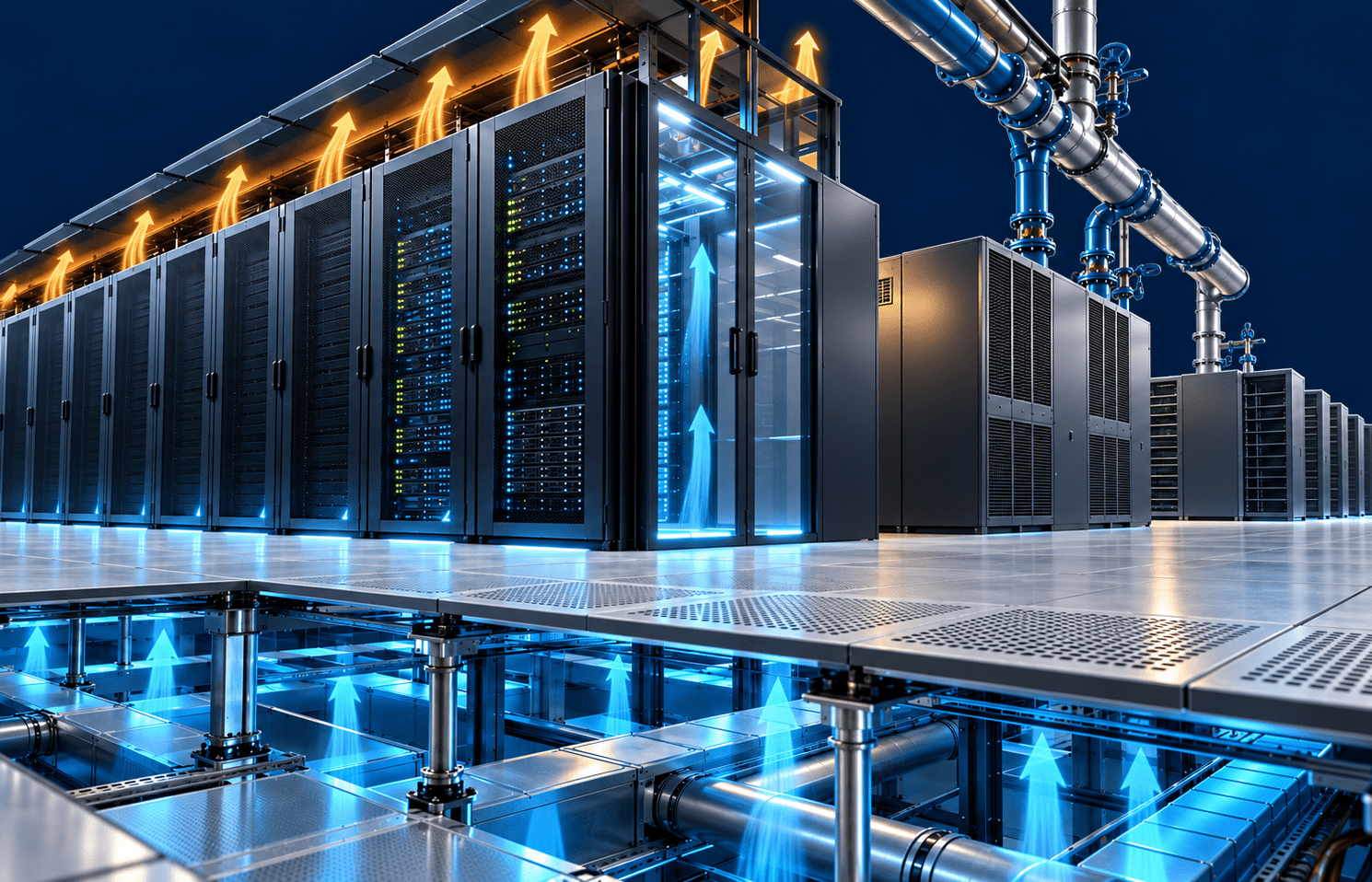
Two data halls with the same total IT load may require different cooling strategies if their loads are distributed differently.
A uniform low-to-medium density allows heat to be managed across a wider floor area. Concentrated high-density racks create local conditions that may not be visible in a building-level load total.
The design team needs clarity on:
- Average and peak rack density
- Location of high-density zones
- Expected load diversity
- Airflow requirements
- Containment strategy
- Potential use of liquid cooling
- Future changes in equipment type
When density assumptions remain open, the data center HVAC design should preserve options. Space for distribution piping, containment, heat exchangers, or additional cooling units may be more valuable than prematurely selecting one fixed architecture.
Expansion Routes Need to Exist in the BIM Model
Future capacity is often present in schedules and diagrams but absent from the coordinated physical model.
When the next phase arrives, teams may discover that:
- Reserved plant space has been occupied
- Future pipe routes conflict with installed services
- Valves and connection points are inaccessible
- Structural openings were not retained
- Equipment replacement routes are obstructed
- Additional electrical infrastructure has no viable pathway
Data center BIM services can make the expansion strategy spatially testable.
The model should show future equipment zones, distribution routes, connection points, access clearances, and removal paths. These elements need clear status so downstream teams can distinguish installed, future, and reserved infrastructure.
A blank area on a plan is not the same as protected expansion space.
Energy Performance Changes Across the Phases
Cooling is a significant part of data center energy use. The US Department of Energy estimates that HVAC can account for approximately 25% to 40% of data center electricity consumption, depending on the facility and system. US Department of Energy
Energy performance should therefore be evaluated at more than the final design point.
A system may operate efficiently near ultimate capacity while performing poorly during the first several years of lower utilization. The analysis should test:
- Minimum and typical day-one loads
- Intermediate expansion stages
- Seasonal operating conditions
- Equipment turndown
- Pump and fan control
- Water-side and air-side economization opportunities
- Interaction between redundant equipment and part-load efficiency
This allows equipment selection and sequencing to reflect how the facility will actually develop.
The Design Basis Needs Controlled Change
IT forecasts will change. The program needs a way to absorb that change without repeatedly reopening the entire data center MEP design.
A controlled design basis should record:
- IT load by phase
- Rack-density assumptions
- Diversity factors
- Environmental criteria
- Redundancy requirements
- Cooling-system boundaries
- Available utility capacity
- Future technology allowances
Each revision can then be assessed for reach. A change in total load may resize the cooling plant. A change in density may alter room-level distribution. A move toward liquid cooling may affect piping, water treatment, controls, and space planning.
Treating every forecast change as a new calculation conceals these different consequences.
Bringing Phasing Into Detailed Engineering
TAAL Tech connects data center heat load calculation, equipment sizing, energy modeling, detailed HVAC engineering, and data center BIM services within one coordinated delivery environment. This enables cooling capacity, redundancy, and future expansion to be assessed against the same phased design basis.
The strongest data center cooling strategy is rarely the one that installs the most capacity earliest. It is the one that keeps every planned phase operable, resilient, and ready for what comes next.