
16
October, 2026
5 Engineering Decisions To Take Before Building a Data Center in the US
Building a data center is a major investment. Yet some of the most expensive problems can begin long before construction, when decisions about power, cooling, equipment layouts, and future capacity are being made.
Across the USA, data center developers are facing growing pressure to deliver infrastructure faster while managing power constraints and construction costs.
According to CBRE's H1 2026 report, capacity under construction across North America's eight primary data center markets reached 7,481 MW, while vacancy fell to 1.4%.
For companies evaluating data center engineering services in the USA, the priority should be getting critical engineering decisions right before they become expensive construction problems.
Here are five decisions worth examining early.
1. Confirm Power Availability Before Finalizing the Design
A suitable site, enough land, and a strong business case are important. But none of them guarantees that a data center can receive the power it needs when it needs it.
Power infrastructure has become a deciding factor in major US data center markets, including Northern Virginia, Dallas-Fort Worth, and Atlanta.
Developers must consider both the power available from the utility and how that power will be distributed throughout the facility.
Before proceeding, ask:
- Is the required electrical capacity available within the planned project timeline?
- Have the total IT load and supporting infrastructure loads been calculated?
- Are transformers, switchgear, UPS systems, and distribution networks appropriately sized?
- Will the electrical infrastructure support future capacity increases?
- Have protection coordination and electrical safety requirements been evaluated?
For developers seeking data center engineering services in Dallas, these considerations are especially important when comparing sites and planning phased infrastructure investments.
A complete data center electrical design should also account for equipment maintenance, operational reliability, and potential changes in power demand.
Why it matters: Discovering electrical capacity limitations after construction planning has advanced can force developers to revise layouts, change equipment specifications, or delay project milestones.
2. Design the Cooling System Around Actual Workloads
Cooling equipment represents a significant investment, and its operating costs continue throughout the data center's life.
But selecting a cooling system involves more than calculating the heat generated by today's servers.
Developers must also consider how workloads may change, particularly as high-density computing and AI infrastructure become more common.
The US Department of Energy's guide identifies cooling systems, air management, and IT environmental conditions as important areas for improving data center energy efficiency.
Effective data center HVAC design should consider:
- Heat-load calculations based on planned IT equipment.
- Chiller, air handling unit, and cooling tower selection.
- Airflow distribution and hot-air management.
- Cooling redundancy and equipment maintenance.
- Future requirements for higher-density racks and liquid cooling.
Location matters, too.
For example, data center engineering in Phoenix must account for the city's hot, dry climate and local water constraints. Cooling strategies suitable for Phoenix may differ considerably from those used in Chicago or Northern Virginia.
Through detailed engineering and energy modeling, developers can evaluate suitable cooling arrangements before making major equipment investments.
Why it matters: Incorrect cooling assumptions can result in oversized equipment, higher operating expenses, insufficient cooling capacity, or costly modifications when computing requirements change.
3. Decide How Much Redundancy the Facility Actually Needs
Reliability is central to data center operations. However, adding more backup equipment does not automatically produce a better facility.
Every additional UPS unit, chiller, generator, or distribution path affects capital costs, maintenance requirements, and available space.
The right redundancy strategy depends on the facility's intended use and the consequences of an interruption.
For instance, a data center supporting business-critical applications may have different availability requirements from a facility hosting workloads that can tolerate planned downtime.
Before choosing a redundancy strategy, developers should establish:
- Which systems must remain operational during maintenance?
- What happens if a critical electrical or cooling component fails?
- Are backup distribution paths adequately separated?
- Does the proposed arrangement support the facility's availability objectives?
- Can maintenance activities be completed without unacceptable disruption?
The Uptime Institute's Tier framework provides established classifications for data center infrastructure, including requirements for concurrently maintainable and fault-tolerant facilities.
These considerations must be reflected across mechanical, electrical, and supporting infrastructure systems.
Why it matters: Overengineering increases investment costs, while inadequate redundancy exposes operators to avoidable operational risks.
A carefully planned approach helps align infrastructure spending with the reliability the business actually needs.
4. Leave Enough Space for Equipment, Maintenance, and Installation
A data center floor plan may look efficient until the mechanical and electrical systems are added.
Electrical rooms, cooling equipment, pipework, cable trays, fire protection systems, and maintenance corridors all require space.
Consider a facility where electrical equipment fits within the designated room, but the clearance needed for servicing conflicts with adjacent mechanical installations.
The equipment may fit on paper, yet installation or maintenance becomes difficult.
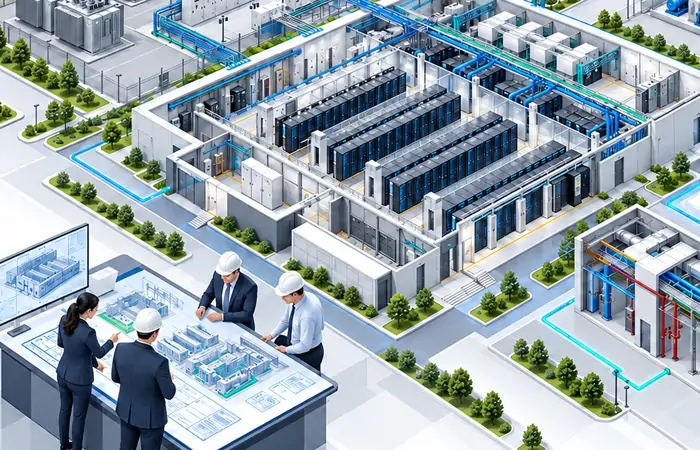
This is why data center MEP engineering should be coordinated during the planning and design stages.
Key considerations include:
- Equipment dimensions and required service clearances.
- Electrical and mechanical distribution routes.
- Access for equipment installation and replacement.
- Fire protection and life safety systems.
- Structural and architectural constraints.
- Space reserved for future upgrades.
For projects involving data center design in Northern Virginia, where land and development constraints can affect planning decisions, efficient space utilization deserves particular attention.
Similarly, data center engineering in Chicago must account for local building requirements, site conditions, and equipment access when developing coordinated layouts.
Why it matters: Poorly coordinated engineering layouts can lead to site modifications, installation delays, and higher maintenance costs.
Resolving these issues during design is generally more practical than making changes after equipment has been ordered or installed.
5. Plan Future Expansion Before Construction Begins
A data center built for today's workloads may need substantially more power and cooling capacity within a few years.
Yet preparing for expansion does not necessarily mean installing all future infrastructure immediately.
The smarter approach is to identify which provisions should be included during initial construction and which investments can follow demand.
Developers should ask:
- Can additional transformers and switchgear be installed later?
- Is space available for future cooling equipment?
- Can mechanical and electrical distribution networks support phased expansion?
- Will new equipment affect existing operations during installation?
- Are building layouts and infrastructure routes flexible enough for future changes?
For companies involved in data center development in Atlanta, where substantial construction activity is underway, planning for scalable infrastructure can support long-term development strategies. CBRE reported that Atlanta led North America's primary markets in capacity under construction during H1 2026.
Careful data center infrastructure planning allows developers to compare phased investments, preserve expansion options, and reduce the likelihood of major redesigns.
Why it matters: A facility that cannot accommodate future workloads may require expensive infrastructure modifications sooner than its owners expected.
How TAAL Tech Supports Data Center Engineering Projects Across the USA
The five decisions discussed above involve multiple engineering disciplines. Power distribution affects equipment layouts. Cooling requirements influence architectural planning. Redundancy strategies affect both space and infrastructure investment.
Managing these dependencies requires coordinated engineering from the beginning.
TAAL Tech provides multidisciplinary data center engineering services for developers, engineering consultants, and contractors working on new facilities, upgrades, and expansion projects.
Our capabilities include:
- Architectural planning: Space utilization, equipment layouts, and infrastructure planning.
- Mechanical engineering: HVAC design, heat-load calculations, chiller and cooling tower sizing, and energy modeling.
- Electrical engineering: Load calculations, single-line diagrams, medium- and low-voltage distribution design, and power system studies.
- Plumbing engineering: Water distribution, drainage, and supporting utility systems.
- Fire protection engineering: Sprinkler systems, clean-agent suppression, detection systems, and smoke management.
- Detailed engineering: Coordinated engineering documentation to support construction and project execution.
Whether a project involves new infrastructure or the expansion of an operating facility, our engineering capabilities can help project teams address design requirements, identify potential conflicts, and prepare coordinated engineering deliverables.
Get the Engineering Decisions Right Before Construction
The performance and long-term cost of a data center are influenced by decisions made well before the first equipment is installed.
Power availability, cooling efficiency, redundancy, equipment layouts, and expansion capacity must be considered together. Getting these decisions right early can help developers avoid unnecessary changes, manage costs, and prepare facilities for future requirements.
Planning a data center project in the USA? Explore TAAL Tech's data center design services and connect with our engineering team to discuss your project requirements.