
3
September, 2026
Aircraft Weight and Balance: Managing the Cumulative Impact of Modifications
A single aircraft modification may add an acceptable amount of weight. The programme risk often emerges after several individually acceptable changes are combined.
A new cabin system adds equipment. Structural reinforcement adds more. Wiring, brackets, cooling provisions and installation hardware follow. Each change passes its own review, while the remaining aircraft-level margin continues to narrow.
For programme leaders, aircraft weight and balance is therefore a configuration and capability decision, not a calculation performed at the end of design.
The Same Added Weight Can Create Different Aircraft-Level Consequences
Added mass cannot be evaluated independently of its location.
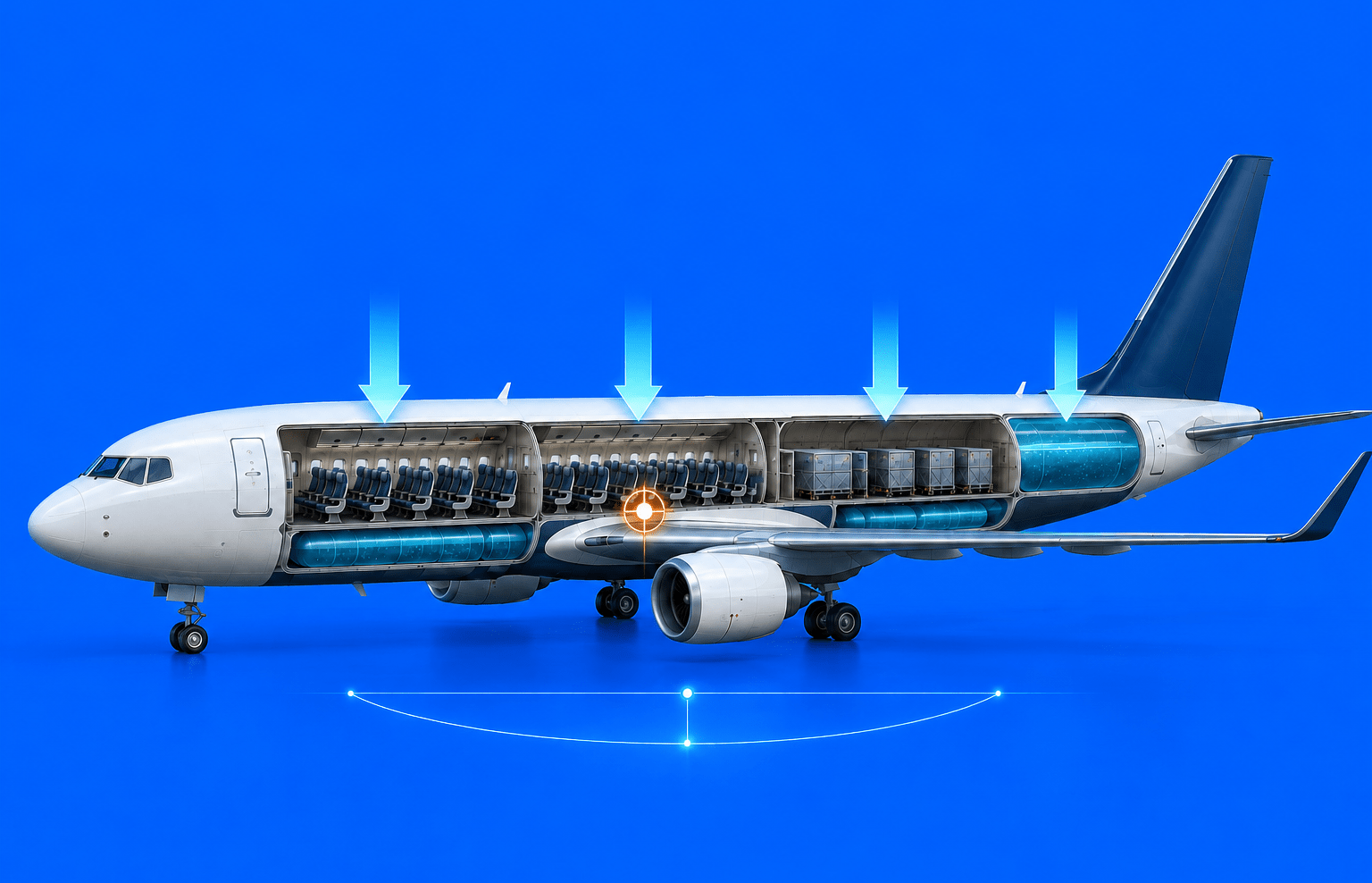
An installation close to the aircraft’s existing centre of gravity may have a limited effect on balance. The same mass positioned further forward or aft can produce a much larger moment and reduce the usable loading envelope.
This distinction matters in aircraft modification engineering because equipment location is often decided around cabin layout, structural access, system routing, maintainability and available space. Weight and CG consequences may enter the discussion only after the preferred location has matured.
The FAA’s Aircraft Weight and Balance Handbook explains the relationship between aircraft weight, arm, moment and centre of gravity, and the need to maintain operation within approved limits.
For programme leaders, the practical implication is clear: a modification needs to be evaluated by mass, position and operational effect together.
Installed Equipment Weight Is Only the Starting Point
Early estimates often focus on the weight of the primary equipment. The final installed change can be materially different once all enabling items are included.
A new system may also require:
- Mounting brackets and support structures
- Structural reinforcement
- Wiring, connectors and circuit-protection equipment
- Ducting or cooling provisions
- Control panels and displays
- Covers, shrouds and interior finishing
- Fasteners, bonding provisions and installation hardware
- Changes to nearby equipment or furnishings
The relevant value for aircraft weight and balance analysis is the complete installed delta. This includes removed equipment, added equipment and secondary changes required to integrate the system.
A modification that replaces a 20 kg unit with a 24 kg unit does not necessarily create a 4 kg aircraft-level increase. Once revised supports, wiring and installation provisions are included, the net change may be larger and distributed across several locations.
This is why programme teams need a modification-level weight breakdown rather than a single equipment figure.
Cumulative Change Is Where Programmes Lose Visibility
Aircraft are rarely modified through one isolated package.
Cabin upgrades, avionics changes, connectivity systems, safety equipment and structural repairs may be developed by different teams or introduced at different programme stages. Each package can remain within its assigned allowance while their combined effect changes aircraft capability.
The cumulative impact may include:
- Increased operating empty weight
- Movement of the empty-weight centre of gravity
- Reduced payload flexibility
- Greater sensitivity to passenger or cargo distribution
- Reduced fuel or range flexibility under weight-limited conditions
- New ballast requirements
- Changes to loading procedures or limitations
The aircraft can remain technically compliant while becoming less useful for its intended mission.
This is an important distinction for senior leaders. Certification determines whether the aircraft can operate within an approved envelope. Programme value also depends on whether the modified aircraft can perform the commercial, governmental or special-mission role for which it is being configured.
A Positive Margin Does Not Always Mean an Acceptable Outcome
An aircraft centre of gravity calculation may show that the modified configuration remains within limits. That result needs to be considered alongside the amount and location of the remaining margin.
A narrow margin can constrain:
- Seating flexibility
- Cargo placement
- Fuel-loading options
- Mission equipment changes
- Future modifications
- Operational recovery when actual weights exceed estimates
For example, a programme may place several new systems in the forward cabin because space and access are available. Every installation remains acceptable independently. When combined with the selected interior configuration, the aircraft may require aft ballast or tighter loading controls.
Ballast restores balance by adding weight that provides no operational capability. It can protect compliance while reducing payload or performance value.
The better decision may involve relocating equipment, redistributing system components or revisiting the cabin arrangement before the installation is frozen.
Weight Maturity Must Follow Design Maturity
Modification weight develops through several levels of confidence:
- Target weight: The allowance established for the modification.
- Estimated weight: An early value based on concepts, supplier information or comparable equipment.
- Calculated weight: A value developed from detailed design and material definition.
- Actual weight: The verified mass of the manufactured or installed item.
Problems arise when programme decisions treat an estimate as though it were an actual value.
A mature aircraft weight control process should identify:
- The source of every weight value
- Its current maturity level
- The margin or contingency being applied
- Its location and moment contribution
- The owner responsible for updating it
- The configuration to which it applies
This helps leaders distinguish between a genuine weight margin and one that exists only because several items still rely on optimistic estimates.
Weight Growth Should Be Managed by Reach, Not Only Magnitude
Not every weight increase carries the same programme consequence.
An additional kilogram near the aircraft centre of gravity may have limited balance impact. The same increase at an extreme location can have greater influence on the overall moment. Weight added to an already constrained zone may also affect local structure, floor loading or system installation.
Programme teams should therefore evaluate weight changes against:
- Distance from the reference datum
- Direction of CG movement
- Existing forward and aft margins
- Mission-loading scenarios
- Structural and floor-loading constraints
- Assigned modification allowance
- Interaction with other planned changes
This allows engineering leaders to prioritise the changes that threaten aircraft-level capability rather than reacting to every variance equally.
Configuration Control Must Include Removed and Retained Items
Incomplete removal data is a common source of uncertainty in aircraft weight and balance analysis.
A modification package may define new equipment precisely while relying on assumptions about the items being removed. Differences can arise when:
- Existing records do not reflect the current aircraft configuration
- Previous modifications have changed equipment or wiring
- Certain brackets, cables or provisions remain installed
- Removal scope varies across aircraft in the same fleet
- Supplier documentation uses a different configuration baseline
The net weight change must represent what physically leaves and enters each aircraft.
For fleet programmes, a single baseline may not be sufficient. Aircraft-specific configuration differences can affect both weight and centre of gravity, even when the same modification kit is installed.
Weight and Balance Data Must Travel Into Operational Documentation
The engineering calculation is only one part of the deliverable.
Approved changes may also need to be reflected in:
- Weight and balance reports
- Equipment lists
- Aircraft flight manual supplements, where applicable
- Loading schedules or systems
- Maintenance and installation records
- Modification and certification documentation
The FAA notes that an aircraft’s empty weight and empty-weight CG are established and recorded as part of its weight and balance record. Subsequent configuration changes must therefore remain connected to the controlled aircraft record. FAA weight and balance guidance
When calculations and equipment records use different baselines, the aircraft can acquire an accurate analysis attached to an inaccurate configuration.
What Programme Leaders Should Review Before Design Freeze
Before a modification configuration is frozen, leaders should be able to answer:
- Does the weight estimate include the complete installed change?
- Are removed, retained and added items clearly identified?
- What is the maturity of each weight value?
- Where does the modification move the empty-weight CG?
- How does it interact with other planned modifications?
- Which mission-loading scenarios are most restrictive?
- Does the aircraft remain operationally useful across its intended envelope?
- Is ballast being used to resolve an avoidable integration decision?
- Are aircraft-specific fleet differences understood?
- Will the approved data flow into all affected records and manuals?
These questions shift the review from numerical compliance to retained aircraft capability.
Protecting Capability While the Configuration Evolves
Aircraft weight and balance should remain active from concept selection through installation and final documentation.
TAAL Tech’s aerospace engineering services connect design, structural analysis, systems integration, aircraft weight control and technical documentation. This allows weight and CG consequences to be evaluated while equipment location and configuration decisions can still be changed efficiently.
Our goal is not simply to keep the aircraft inside its approved limits. It is to preserve as much payload, mission and future-modification flexibility as the programme can retain.