21
August, 2026
From Design Intent to Permit-Ready Documentation: Where Architecture Production Support Adds Value
There is a point in every project where design stops being the only challenge.
The concept may be approved. Key layouts may be settled. The client may already be looking ahead to the next milestone. Yet the project still has to survive the transition into a coordinated, technically complete and permit-ready package.
That transition is where production pressure builds.
Not because the design team lacks capability, but because every decision now has to be translated across models, drawings, details, schedules and multidisciplinary inputs, often against a fixed submission date.
For architecture firms, this is where architectural documentation services can protect both delivery pace and senior design time.
The Most Expensive Problems Often Appear After the Design Looks Finished
A design can look resolved on screen and still contain dozens of unresolved production dependencies.
A ceiling change affects services coordination. A structural revision alters an opening. A fit-out decision moves a partition. A late client comment travels through plans, elevations, schedules and details.
None of these changes is extraordinary on its own. The risk comes from how many places each one touches.
That is why strong architectural production services are less about drawing volume and more about maintaining continuity between the live design model and the documents being prepared for issue.
A team providing Revit modeling services and documentation support can keep those changes moving through the package while the core architecture team remains focused on design decisions, reviews and client coordination.
Permit Delivery Is a Coordination Problem Disguised as a Documentation Problem
A permit set may be issued as drawings, but the quality of that submission depends heavily on what happened before the drawings were assembled.
- Are the architectural and structural models aligned?
- Have MEP interfaces been reflected correctly?
- Are schedules consistent with plans?
- Have repeated elements been modeled through standardized Revit families?
- Are design changes still sitting in markups rather than the live model?
These are production questions, but they directly affect delivery confidence.
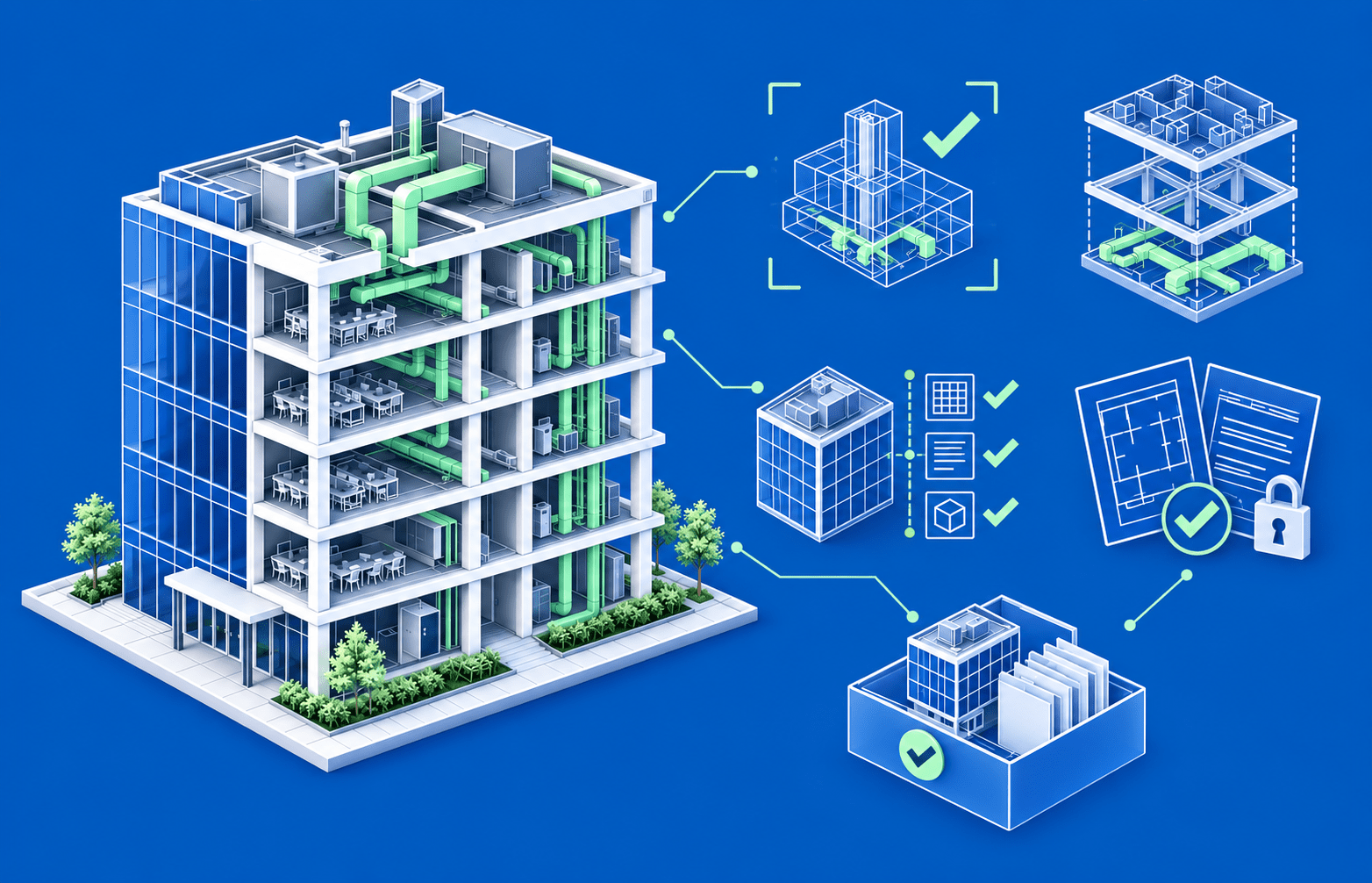
This is where permit drawing services become more valuable when they are connected to BIM coordination services, rather than handled as an isolated drafting activity.
The earlier those interfaces are resolved, the less pressure accumulates at the end of the documentation cycle.
Production Scale Should Not Create Production Noise
Adding more people to a project can solve a capacity problem and create a consistency problem at the same time.
That is why scale depends on standards.
Revit templates, parametric families, naming conventions, sheet structures and agreed modeling practices create the framework that allows an extended production team to work as part of the same delivery environment.
For firms working across recurring project types, large programmes or long-term clients, this matters even more.
The objective is not to recreate the production process every time demand increases. It is to create a production environment that can absorb more work without changing how the firm operates.
This is also where automation starts to become relevant. Repetitive model updates, data handling and documentation tasks can often be reduced or standardized, freeing teams to spend more time on work that actually requires design judgment.
Where TAAL Tech Fits Into the Delivery Chain
At TAAL Tech, we support architecture firms across the production stages that sit between design development and final documentation.
That includes BIM modeling services, detailed architectural drawings, interior and fit-out detailing, permit-set production, multidisciplinary coordination, Revit family and template development, CAD to BIM, PDF to BIM, point cloud to BIM and production automation.
The engagement does not have to begin with an entire project. It can begin with a documentation package that needs more capacity. A Revit model that needs to be developed further. A permit milestone that requires additional production support. Or a recurring workflow that needs a more scalable delivery model.
The broader value is simple.
Architecture firms should not have to choose between maintaining design focus and keeping production moving.
With the right architectural documentation services in place, they can do both.
If your team is approaching a documentation or permit-heavy project phase, connect with TAAL Tech to explore how we can support the production workload.