
23
January, 2026
Data Center Cooling Strategies: Air, Liquid, and Direct-to-Chip Systems Explained
AI, HPC, and dense cloud workloads are quietly rewriting the rules of data center cooling. Power densities that used to plateau at 5–10 kW per rack are now routinely 30–80 kW, and AI clusters can push 80–120 kW per rack or more.
At the same time, the global average PUE has been stuck in the 1.55–1.60 band for years, meaning cooling and other overheads still consume a large share of site energy. Cooling alone can represent 20–50% of a data center’s total electricity use, making it one of the biggest levers for both cost and sustainability.
In this context, understanding how you cool – and how you model and coordinate those systems – is now a strategic design decision, not an afterthought.
1. Air-Based Cooling: CRAC/CRAH, In-Row, and Rear-Door Systems
Traditional CRAC / CRAH + room-level air
The classic model is familiar:
-
- CRAC (Computer Room Air Conditioner) units use DX refrigerant systems
- CRAH (Computer Room Air Handler) units use chilled water coils fed from central plant
- Air is supplied via raised floor or overhead, organized into hot/cold aisles, with return air back to the units
-
- Small DX or chilled-water units placed between racks in the aisle
- Shorter air paths from coil to IT inlet, reducing mixing and fan power
- Typically used in high-density pods (e.g., 20–40 kW per rack)
-
- Hot exhaust air passes through a chilled-water coil integrated into the door
- Heat is removed at the rack, and near-neutral air is discharged into the room
- This significantly reduces room-level thermal burden
-
- Chilled water loops feed in-row coolers or RDHx
- Air still cools the IT directly; liquid removes heat from coils near the rack
- The room becomes more of a “buffer” environment, easing constraints on layout
-
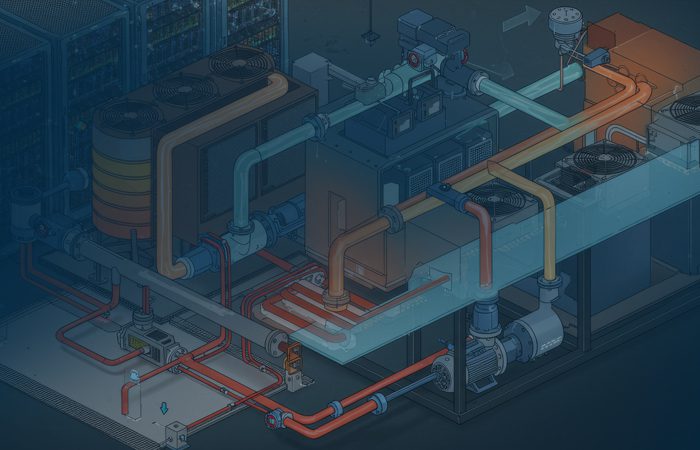
- Coolant flows through cold plates in direct contact with the chip package
- A rack or row manifold distributes and collects coolant, feeding a CDU (cooling distribution unit)
- CDUs connect to facility water, often via liquid–liquid heat exchangers
-
- Coolant chemistry and wetted materials (to avoid corrosion and contamination)
- Redundancy and failover paths in the coolant network
- Leak detection, drip trays, and structured routing to protect other equipment
-
- Servers are submerged in a dielectric fluid (single-phase or two-phase)
- Heat from components is absorbed by the fluid and transferred via heat exchangers
- Rack power densities of 100 kW are common, with some dual-phase systems exceeding 150 kW per rack.
-
- Service workflows (how you swap components in/out of tanks)
- Hardware choices (immersion-ready hardware & materials)
- Integration with existing facility cooling and fire protection philosophies
-
- Higher coolant temperatures → more free cooling opportunities and better chiller efficiency
- Reduced fan power → fans in IT and CRACs/CRAHs can be down-sized or eliminated
- Targeted cooling → less overcooling of entire rooms for a few hot racks
-
- Topology choices
- Air-only with advanced containment and RDHx may work up to certain densities
- Beyond that, you’re likely in hybrid (air + RDHx / in-row) or full DLC / immersion territory
- Hydraulic and thermal modeling
- Temperature set-points and ΔT targets along the liquid path (chip → cold plate → manifold → CDU → facility water)
- Pressure drop, pump selection, and redundancy in the loop
- Mechanical–electrical–controls coordination
- Power distribution must be aligned with rack density, redundancy (N, N+1, 2N), and cooling capabilities
- Controls logic for fans, pumps, valves, CDUs, chillers and economizers must be consistent and thoroughly tested
- Safety and risk management
- Leak detection (sensors, drip trays, isolation valves) integrated into the DCIM/BMS
- Materials compatibility with coolants, and fail-safe behavior under loss-of-coolant scenarios
- Topology choices
-
- High-fidelity cooling topology modeling
- Detailed Revit / BIM models capturing coolant loops, manifolds, CDUs, RDHx, in-row coolers, overhead coils
- Accurate pipe routing with support systems, slopes (where needed), valve locations, and redundancy paths
- Representing containment zones (hot/cold aisles, pods, immersion tanks) as first-class BIM objects
- Mechanical–electrical–controls integration
- Coordinated MEP models linking cooling plant, pump rooms, white space piping, and electrical distribution
- Controls architectures modeled to align with OEM standards (e.g., Schneider, Vertiv) and ASHRAE TC 9.9 guidance
- Embedded data tags for flow, temperature, and redundancy attributes to support downstream commissioning & DCIM integration
- Simulation-ready geometry and data
- Creating CFD-ready geometry and attributes for partners or in-house teams to run thermal simulations at rack / pod level
- Using simulation outcomes to refine containment strategies, set-points, and aisle-level airflow/liquid flow distribution
- Standards and library development
- Developing reusable families and detail libraries for CRAC/CRAH units, RDHx, pipe fittings, quick-connects, leak-detection components, etc.
- Standardizing naming, parameters, and metadata so that models are consistent across regions and projects
- High-fidelity cooling topology modeling
-
- A capacity limiter for how much compute you can deploy in a given footprint
- A top-three contributor to energy and carbon performance
- A complex integration problem spanning mechanical, electrical, controls, OEM hardware, and operational workflows
-
- Confidently design for 30–80 kW+ racks and AI clusters
- Quantify PUE and energy impacts early in the design process
- Deliver fully coordinated mechanical–electrical–controls models that slot cleanly into OEM ecosystems and ASHRAE-aligned best practices