
1
July, 2026
BIM Services for Faster Project Delivery and Reduced Rework
A project rarely goes off track because of one big mistake. More often, it is a series of smaller misses.
A duct clashes with a beam. A drawing revision does not reach every team. A ceiling zone gets crowded. A site team works from outdated information. By the time the problem is noticed, the cost is no longer limited to design correction. It affects procurement, installation, schedule, manpower, and client confidence.
This is where BIM services have become critical for engineering firms. BIM helps teams move from disconnected drawings to coordinated, data-rich models that improve visibility before work reaches site.
For firms working on complex buildings, industrial facilities, infrastructure, healthcare spaces, data centres, and commercial projects, BIM is no longer only a 3D modelling activity. It is a project delivery discipline.
Why Rework Happens in Engineering Projects
Rework usually begins with information gaps.
Different teams may work on separate files. Architectural, structural, MEP, fire protection, equipment, and civil inputs may move at different speeds. Changes may be shared through emails, PDFs, markups, calls, and spreadsheets.
That creates room for mismatch.
Common causes include:
- Design clashes between disciplines
- Outdated drawings used for coordination
- Poorly defined model ownership
- Missing equipment clearances
- Inconsistent levels of detail
- Late design changes
- Weak coordination between design and construction teams
Autodesk’s digital project delivery research notes that poor data and communication continue to be a major cause of construction rework globally. That makes information quality a delivery issue, not only a documentation issue.
How BIM Services Reduce Rework
BIM services help engineering firms identify problems before they become site issues.
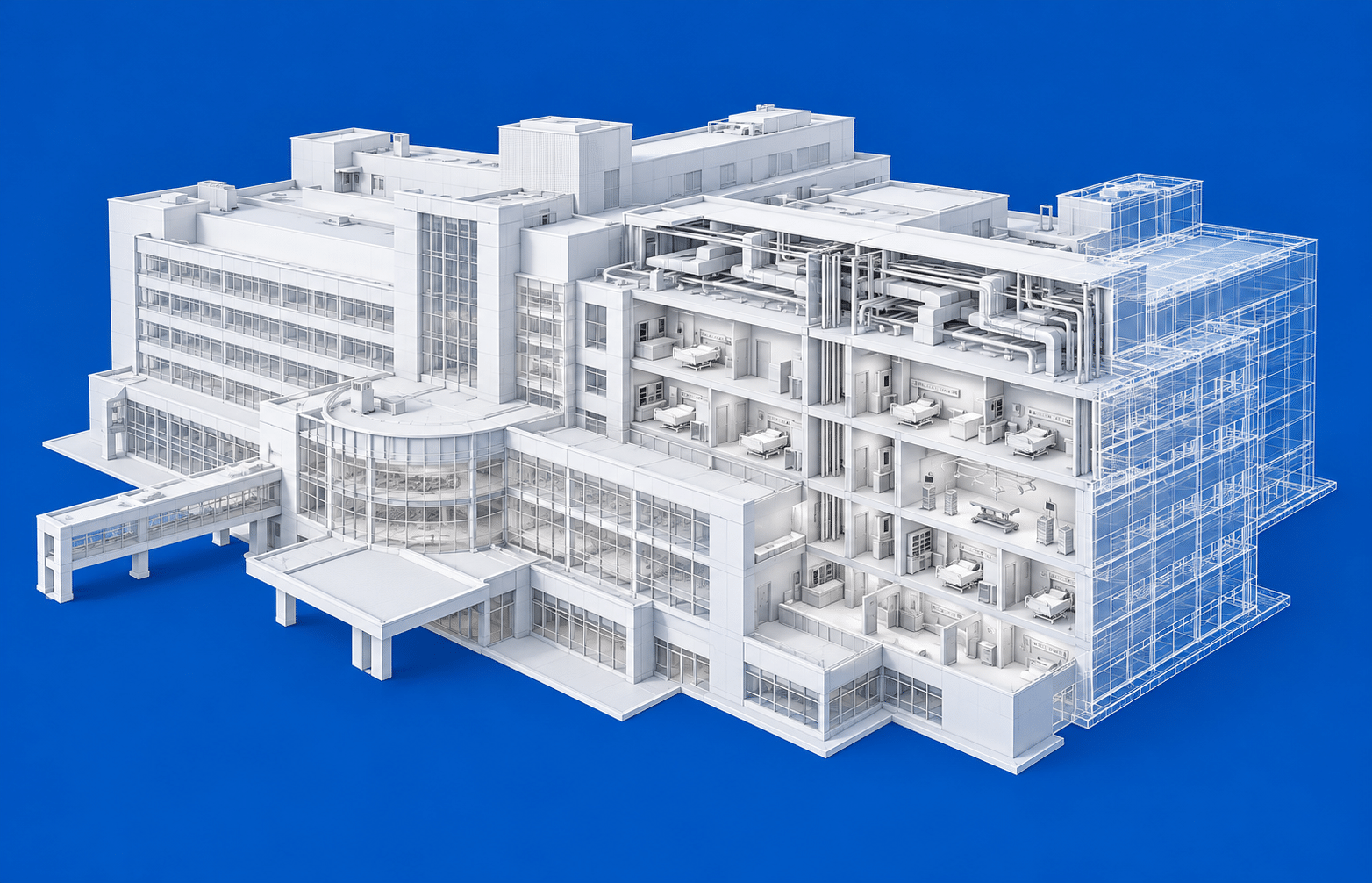
A coordinated BIM model brings different disciplines into one digital environment. Instead of checking drawings in isolation, teams can review how systems actually interact in space.
This helps with:
- Clash detection and resolution
- MEP coordination
- Constructability review
- Space planning
- Equipment access planning
- Quantity extraction
- Drawing generation
- Model-based issue tracking
For example, an HVAC duct may look correct in a standalone drawing. In a coordinated BIM model, the same duct may clash with a structural beam, cable tray, sprinkler pipe, or access panel. Finding that issue during modelling is far cheaper than finding it after installation starts.
This is the practical value of BIM. It gives teams time to fix problems when the cost of change is still manageable.
BIM Helps Teams Work from the Same Information
Good BIM delivery is not only about creating a good-looking model. The real value comes from managing project information clearly.
The ISO 19650 series provides an international framework for information management using BIM, including how information is exchanged, recorded, versioned, and organized across project actors.
For engineering firms, this matters because model coordination can fail if information management is weak.
A strong BIM workflow defines:
- Who owns which model elements
- What level of detail is required
- How revisions are controlled
- How clashes are raised and closed
- Which model becomes the source of truth
- How drawings and schedules are generated
- How model data is handed over
Without this structure, BIM can become another disconnected deliverable. With the right process, it becomes a coordination engine.
Where BIM Services Add the Most Value
BIM services are especially useful when projects involve multiple disciplines, tight spaces, frequent revisions, or high coordination risk.
They add value in:
- MEP-heavy projects
Hospitals, airports, data centres, laboratories, and commercial buildings often have dense service zones. BIM helps coordinate HVAC, electrical, plumbing, fire protection, and equipment layouts before site installation.
- Industrial facilities
Plants involve equipment, pipe racks, platforms, ducts, utilities, access areas, and maintenance zones. BIM helps engineering teams review how the facility will actually function after construction.
- Brownfield upgrades
Existing facilities often come with incomplete drawings. Scan-to-BIM and as-built modelling help teams plan modifications with better accuracy.
- Fast-track projects
When timelines are tight, BIM helps teams coordinate faster, reduce review cycles, and avoid late-stage surprises.
- Projects with remote teams
Engineering firms working across locations need a shared digital environment. BIM helps reduce dependency on scattered files and manual follow-ups.
BIM and Better Project Delivery
Project delivery improves when teams can see issues early, review options clearly, and make decisions based on coordinated information.
BIM services support delivery through:
- Faster interdisciplinary coordination
- Better design visualization
- Reduced site queries
- More accurate construction documentation
- Improved quantity take-offs
- Stronger change management
- Better handover data for operations
A buildingSMART survey found that BIM users reported better decision-making, improved quality, and faster collaboration as leading benefits. These are delivery outcomes, not only design benefits.
What Engineering Firms Should Look for in BIM Support
The right BIM partner should understand more than software.
Engineering firms should look for BIM support that can manage:
- Discipline-specific modelling
- Clash detection workflows
- BIM execution plans
- LOD requirements
- Shop drawing support
- Scan-to-BIM
- Revit family creation
- Navisworks coordination
- Common data environment workflows
- As-built model updates
The partner should also understand how engineers, contractors, architects, and site teams use information differently. A model that is technically detailed but difficult to use will not improve delivery.
How TAAL Tech Supports BIM Services
At TAAL Tech, we support engineering and construction teams with BIM services that improve coordination, documentation, and project visibility.
Our teams work across architectural, structural, MEP, plant, and infrastructure-related requirements. We help clients create coordinated models, detect clashes, prepare construction documentation, manage revisions, and support project teams with scalable BIM capacity.
Our goal is simple: help engineering firms reduce avoidable rework, make project information easier to use, and deliver with greater confidence.