
10
February, 2026
Lighter Cabins, Stronger Systems: How Composites Are Redefining Aircraft Interiors
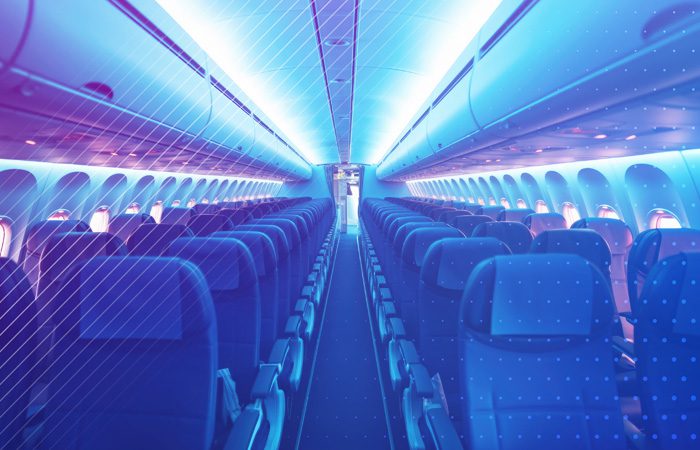
Walk into a modern aircraft cabin and you’ll see mood lighting, slimline seats, quiet cabins, and sculpted sidewalls. What you don’t see is the real revolution: composite materials quietly replacing metal in almost every corner of the interior to shave kilos without sacrificing strength, safety, or passenger comfort.
For airlines under pressure to cut emissions, increase range, and add revenue-generating features, every kilogram matters. That’s why the biggest shift in cabin engineering today is simple to describe but hard to execute:
Use composites wherever possible to minimize structural weight – without compromising strength, safety, or function.
This blog looks at how that shift is unfolding inside the cabin, and how engineering partners like TAAL Tech support OEMs, Tier-1s, completion centers, and MROs in making it real.
Why Weight in the Cabin Matters So Much
Newer aircraft platforms with composite-rich primary structures have shown how much fuel and maintenance savings are possible when you remove weight intelligently. Interior systems may not carry wing-level loads, but they occupy a huge portion of the fuselage volume: sidewalls, ceilings, floor panels, galleys, lavatories, overhead bins, monuments, partitions, and seats.
Across an aircraft program:
-
- Saving 20–30% weight on interior components can translate into hundreds of kilograms per aircraft.
- Over thousands of flight hours, that reduction compounds into lower fuel burn, higher payload flexibility, and reduced CO₂ per passenger.
- Airlines get more freedom to add features—IFEC, in-seat power, connectivity hardware—without paying an excessive weight penalty.
In an environment where fuel and sustainability pressures are only rising, cabin weight is now a strategic lever, not a mere design detail.
What “Composite” Really Means in Aircraft Interiors
In the cabin, “composites” is not one material—it’s a toolbox of solutions.
Sandwich Panels
These are thin composite face sheets bonded to a lightweight core, typically honeycomb. They are everywhere in the interior, because they offer very high stiffness at very low weight. You’ll find them in:
-
- Sidewall and ceiling panels
- Class dividers and partitions
- Wardrobes and stowage units
- Galley and lavatory shells
- Floor panels and access hatches
By tuning core type, thickness, and face-sheet lay-up, engineers can hit very specific stiffness, strength, and acoustic targets while keeping density under tight control.
Carbon- and Glass-Fiber Laminates
Carbon- and glass-fiber laminates are used in:
-
- Seat frames and beams
- Armrests, tray tables, and shrouds
- Structural inserts and support brackets
These laminates can be tailored to follow load paths, putting material only where it’s actually needed, instead of “over-designing” with thick metallic sections.
Thermoset vs. Thermoplastic Composites
-
- Thermosets (e.g., epoxy systems) dominate many legacy programs. They’re well understood from a certification and manufacturing standpoint.
- Thermoplastics (e.g., PEEK, PEKK, PPS) are gaining share in interior applications because they are:
- Tough and damage-tolerant
- Weldable and reformable
- More recyclable than traditional thermosets
In certain brackets, clips, and structural sub-elements, thermoplastic composites can deliver 20–50% weight savings over metallic counterparts while simplifying assembly.
Specialty Fibers and Cores
Specialty fibers such as aramid (Kevlar®) in honeycomb cores provide excellent impact resistance and extremely low density—ideal for high-stiffness interior panels that still need to survive baggage impacts and day-to-day abuse.
Where TAAL Tech fits: Our interior engineering teams work across this material spectrum—supporting OEMs, Tier-1s, and completion centers with design, stress, flammability, and manufacturing engineering for composite-rich cabins.
Where Composites Are Transforming the Cabin
| Area | What’s Changing | Typical Applications | Data Point | TAAL Tech Angle |
| Panels, partitions & monuments | Metal / solid laminates → composite sandwich (honeycomb) panels | Sidewalls, ceilings, class dividers, wardrobes, galley & lav shells, floor panels/doors | 20–40% weight reduction vs older designs while maintaining stiffness & durability | Re-optimizes panel cores, face sheets & attachments; FEA on hardpoints to get double-digit weight cuts without changing interfaces/cert. |
| Seats & seat structures | Seat frames, brackets & supports moving to carbon and thermoplastic composites | Seat frames, beams, armrests, tray tables, under-seat structures | Composite seat frames can deliver ~30% lower weight vs aluminum; further gains via thermoplastic brackets | Topology-optimized brackets & structures that cut part count and weight while maintaining crashworthiness & HIC targets. |
| Overhead bins & stowage | Composite/thermoplastic bins with integrated ribs and thinner walls | Overhead bins, closets, stowage modules, local brackets | Composite-intensive bins and brackets can see up to ~50% weight savings on some sub-components | Benchmarks metal vs composite options, defines standard laminate/core “families” and creates a bin design playbook reusable across fleets. |
The Engineering Challenge: Not Just Lighter, But Certifiable
Making something lighter is easy. Making it lighter, certifiable, manufacturable, and maintainable is where aerospace interior engineering earns its keep.
- Flammability and Smoke Toxicity
Interior materials must comply with stringent flammability and smoke-toxicity requirements (e.g., vertical burn, heat release, smoke density). For composites, that means:
-
- Choosing resins and core systems that self-extinguish within test limits
- Managing heat release and smoke density within regulatory thresholds
- Avoiding toxic by-products in a fire scenario
Our teams support customers with material down-selection, coupon test planning, and certification documentation, making sure flammability and FST considerations are built into the design from day one, not treated as a late-stage patch.
- Structural Performance and Passenger Comfort
Interior composites must withstand:
-
- Emergency landing load cases
- Turbulence and passenger/baggage abuse
- Localized loads at hinges, latches, and equipment hardpoints
At the same time, they influence comfort and NVH performance, for example through acoustic layers or vibration damping features integrated into panel stacks.
TAAL Tech’s stress engineers routinely use finite element analysis and classical hand calculations to validate composite panels, seat structures, and monuments against certification load cases—crash, pressure, abuse—while collaborating with design teams to keep manufacturability and weight in balance.
- Manufacturability and Repair
The best design on paper fails if it cannot be produced at rate or repaired on-wing.
Key practical questions:
-
- What are the curing or processing cycle times?
- Can we simplify tools and reuse them across multiple part families?
- How easy is it to perform standard repairs (patches, bonded doublers, replaceable modules)?
- Are we standardizing on a sensible set of core types and laminate “families” to keep supply chain complexity under control?
Our manufacturing engineering teams at TAAL Tech help define panel families, preferred core materials, and standard laminate stacks, so clients can reuse building blocks across programs—reducing non-recurring cost and simplifying MRO practices.
Thermoplastics, Automation, and the Next Wave of Cabin Composites
The next big step in cabin interiors combines thermoplastic composites with automation.
-
- Thermoplastic composites
- Enable welded or snap-fit construction instead of riveted assemblies
- Offer improved damage tolerance and recyclability
- Support faster cycle times in high-volume parts
- Automated tape laying and fiber placement
- Deliver highly repeatable quality
- Allow tailored reinforcement zones in complex 3D geometries
- Reduce scrap rates and touch labor
- Hybrid metal–composite solutions
- Use composites where stiffness-to-weight is critical
- Retain aluminum or titanium in highly loaded or thermally demanding zones
- Sustainability-driven design
- Lighter interiors contribute to lower lifecycle emissions
- Recyclable thermoplastics improve end-of-life options
- Smarter structures enable future upgrades without full replacements
- Thermoplastic composites
In real programs, airlines and OEMs rarely transform everything overnight. They move in modular steps: a lighter lavatory shipset here, thermoplastic bins there, composite brackets in the next seat generation. The role of a good engineering partner is to stitch these individual wins into a coherent roadmap that aligns with certification, MRO strategy, and fleet planning.
How TAAL Tech Helps: From Concept to Installation-Ready Design
For TAAL Tech, “use composites wherever possible” isn’t a slogan—it’s embedded into how we engineer lighter, safer interior systems without adding program risk.
Our aerospace engineering services cover:
-
- Interior & structural design for cabins, monuments, and systems
- Stress analysis and optimization
- Flammability and FST support
- Manufacturing engineering
- Sustenance engineering for in-service fleets
Across multiple programs, we see the same pattern: our teams co-engineer with OEMs, Tier-1s, completion centers, and MROs to identify high-impact composite substitutions, quantify weight and cost impacts, and turn them into certifiable, production-ready designs that can repeat across fleets and platforms.
Closing Thought
The future of aircraft cabins isn’t just more screens, smarter lighting, or fancier seats. It’s clever structure: composite-rich interiors that quietly remove kilos, cut fuel burn, and unlock design freedom while still meeting the toughest certification standards.
For aerospace organizations modernizing interiors—whether for new platforms, VIP completions, or heavy maintenance checks—the question is no longer “Should we use composites?”
It’s “Where can we safely use more of them—and who can help us engineer that change without adding program risk?”
That’s exactly the space where TAAL Tech’s aerospace engineering teams operate every day—helping customers design lighter, stronger, certifiable interior systems that are ready for the next generation of flight.