
24
June, 2026
How Legacy Parts and Equipment Can Be Digitally Recreated
Many industrial companies still depend on legacy parts, old machines and equipment that no longer have accurate drawings. When a part fails, wears out or needs redesign, the lack of CAD data becomes a serious problem.
This is why reverse engineering services are becoming more important. The 3D scanning market, which supports many reverse engineering workflows, was valued at USD 5.1 billion in 2024 and is expected to grow at 11.4% from 2025 to 2034, according to Global Market Insights. For engineering teams, the value is clear: existing physical parts can be converted into usable digital models.
What Are Reverse Engineering Services?
Reverse engineering services involve studying an existing part, product, assembly or machine to recreate its design information.
The process may include:
- 3D scanning
- Manual measurement
- CAD reconstruction
- Surface modeling
- Parametric modeling
- 2D drawing creation
- Material and feature analysis
- Assembly study
- Design improvement
- Manufacturing documentation
The goal is to convert a physical object into digital engineering data that can be used for manufacturing, redesign, validation or documentation.
When Do Companies Need Reverse Engineering?
Reverse engineering is useful when original design data is missing, outdated or incomplete.
Common situations include:
- Old drawings are unavailable.
- CAD models do not exist.
- A supplier has stopped manufacturing a part.
- Legacy equipment needs repair.
- A part must be redesigned for better performance.
- A physical part needs to be inspected against design intent.
- Manufacturing needs updated drawings.
- Equipment must be localized or modified.
- Obsolete components need replacement.
- An existing product needs digital documentation.
For companies operating long-life assets, this is often essential.
1. Legacy Part Recreation
Many industrial machines operate for decades. Over time, original drawings get lost, vendors change or parts become obsolete.
Reverse engineering services help recreate such parts by capturing dimensions, geometry and functional features.
This can support:
- Spare part development
- Replacement part manufacturing
- Equipment repair
- Vendor change
- Local manufacturing
- Design standardization
Accurate CAD models reduce dependency on old paper drawings or unavailable suppliers.
2. 3D Scanning and CAD Reconstruction
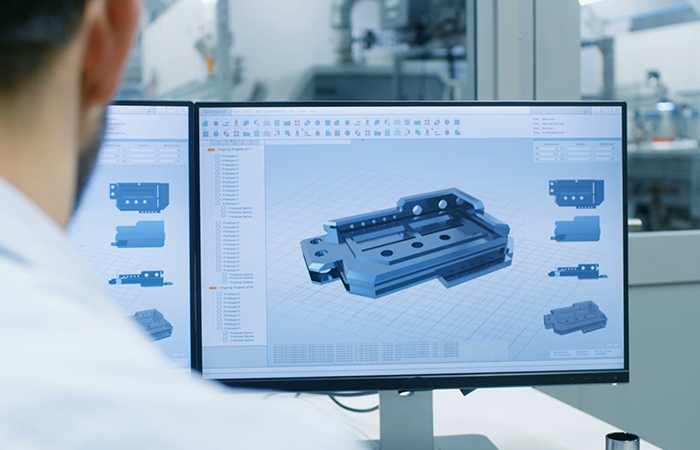
3D scanning captures the geometry of a physical object as point cloud or mesh data. This data is then converted into usable CAD models.
The reverse engineering workflow usually includes:
- Scanning the part
- Cleaning scan data
- Aligning geometry
- Extracting key features
- Creating surfaces or solids
- Building parametric CAD models
- Preparing manufacturing drawings
- Checking accuracy
For complex shapes, castings, housings, worn parts or freeform surfaces, scanning can be faster and more accurate than manual measurement alone.
3. From Physical Part to Editable CAD Model
A scanned mesh is not the same as a usable CAD model. Engineering teams often need editable CAD data.
Depending on the requirement, reverse engineering can produce:
- Parametric CAD models
- Surface models
- Solid models
- Assembly models
- 2D manufacturing drawings
- Inspection models
- Tooling models
Editable CAD models allow engineers to modify features, update tolerances, improve design and prepare production-ready documentation.
4. Reverse Engineering for Design Improvement
Reverse engineering is not limited to copying an existing part. It can also support redesign.
Teams may use reverse engineering to:
- Reduce weight
- Improve strength
- Simplify manufacturing
- Replace unavailable materials
- Improve assembly fit
- Add new features
- Improve serviceability
- Adapt a part to new equipment
This is useful when legacy parts perform well but need modernization.
5. Reverse Engineering for Manufacturing Continuity
Manufacturing delays can occur when parts are unavailable or documentation is incomplete.
Reverse engineering helps create the technical data needed for production.
This may include:
- Part drawings
- Assembly drawings
- Tolerances
- Material specifications
- CAD files
- BOMs
- Tooling inputs
- Inspection references
For companies with critical equipment, this helps reduce downtime risk.
What Inputs Are Required?
Reverse engineering projects may require:
- Physical part or assembly
- Existing drawings, if available
- Photographs
- Operating context
- Material information
- Functional requirements
- Wear history
- Fitment details
- Manufacturing method
- Required output format
The more context the engineering team has, the better the final model will be.
Accuracy Matters
Accuracy depends on the purpose of the reverse engineering project.
For example:
- A visual model may need basic geometry.
- A manufacturing model needs accurate dimensions and tolerances.
- A fitment-critical part needs detailed interface accuracy.
- A redesign project needs functional understanding.
- A replacement part may need material and performance checks.
The engineering partner should define the accuracy requirement before starting the project.
What to Look for in a Reverse Engineering Partner
Before choosing a reverse engineering services provider, companies should ask:
- Can they handle both scanning and CAD modeling?
- Do they understand manufacturing requirements?
- Can they create editable CAD models?
- How do they verify accuracy?
- Can they support complex geometry?
- Do they provide 2D drawings and documentation?
- Can they suggest design improvements?
- Do they understand assemblies and interfaces?
- Can they support material and manufacturing constraints?
- Can they manage sensitive design data securely?
A good partner should understand both geometry capture and engineering intent.
Common Mistakes to Avoid
Reverse engineering projects can fail when teams:
- Treat scan data as final CAD
- Ignore functional requirements
- Skip tolerance planning
- Do not account for worn surfaces
- Miss assembly interfaces
- Use incomplete measurements
- Create non-editable models
- Ignore manufacturing feasibility
The best results come from combining scanning, engineering judgment and manufacturing knowledge.
TAAL Tech’s Role in Reverse Engineering Services
At TAAL Tech, we support reverse engineering services for industrial equipment, plant systems, machinery, aerospace support equipment and manufacturing applications.
Our teams help convert legacy parts, old equipment and physical components into CAD models, drawings, assemblies, BOMs and manufacturing-ready documentation.
The focus is to help companies recover missing design data, improve legacy equipment support and keep critical engineering programs moving.