
23
October, 2026
Designing Future Ready Automotive Components for the European Automotive Market
The automotive market in Europe is evolving rapidly, and so are the demands placed on suppliers of automotive components. According to the European Commission, overall CO 2 emissions from new passenger cars across the region dropped 28 percent between 2019 and 2024.
Electrification, evolving materials, and regulatory guidelines will require manufacturers and suppliers to consider different approaches to automotive component design.
For automotive component suppliers and original equipment manufacturers (OEM), these changing design requirements means finding solutions that balance lightweight construction with impact resistance, cost, and manufacturability.
What Challenges Do Automotive Component Manufacturers Face Across Europe?
European automotive suppliers and OEMs have had to incorporate new design requirements driven by improved vehicle efficiency and the cost effectiveness of production.
Electric vehicles present evolving packaging, structural, and thermal requirements as manufacturers continue to adapt conventional vehicle architecture.
Regulatory requirements are also leading to design changes, including the EU's End-of-Life Vehicles (ELV) Regulation adopted in August 2026.
This directive includes new requirements related to reuse, recyclability, and recoverability of components and materials with most provisions taking effect from September 2028.
These requirements mean automotive engineers have to consider materials use, accessibility, manufacturing methods, and end-of-life management much further along in the development process.
An automotive component that meets performance requirements can have unexpected impact on cost due to weight, tooling, and repair considerations.
Automotive component engineers have to evaluate each possible design change based on how it affects performance, manufacturability, and lifecycle cost.
Below are some strategies you can apply today to help your design engineers and analysts work closer together for better-informed design decisions.
1. Designing Automotive Components That are Lightweight Without Sacrificing Performance
Reducing overall vehicle weight is one of many engineering priorities as manufacturers consider battery weight, efficiency, range, and performance.
Striving for a lighter automotive component by reducing thickness or using less material may create unforeseen stress points in brackets, chassis parts, and sheet metal components.
Weight reduction must be carefully balanced against the performance characteristics of an automotive component. Each design change has to be evaluated based on material properties, strength requirements, and manufacturing implications such as tooling and joining methods involved.
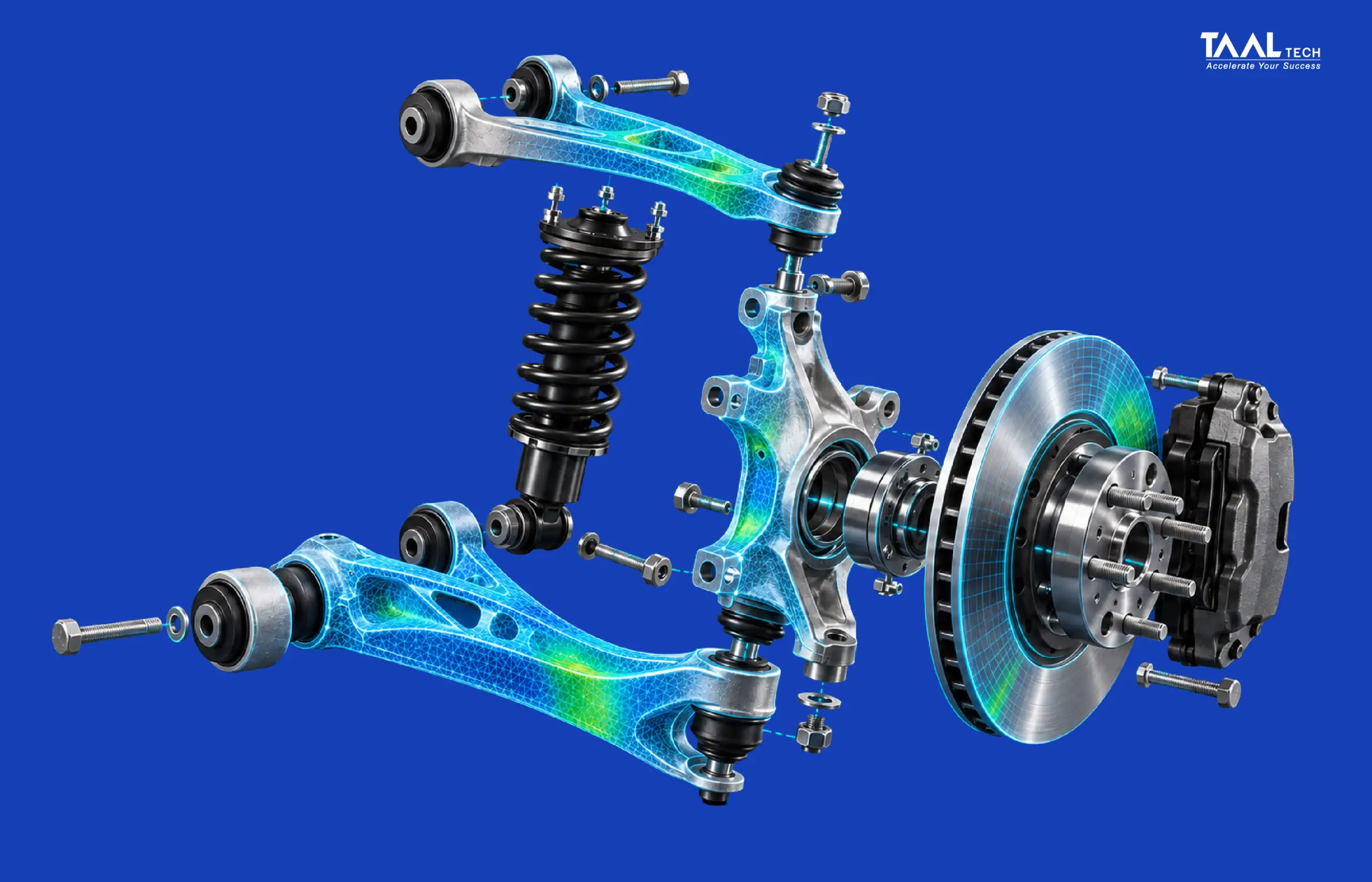
Engineering teams can use automotive CAD and finite element analysis to examine the effects of each design change on performance. Weight reduction can be accomplished in some cases by changing the geometry of a mounting bracket rather than removing material. The resulting design can have improved stress distribution and reduce risk of cracking around points of articulation.
2. Consider Manufacturing Implications of Each Automotive Component Design
An ideal bracket design for a proposed chassis mounting application may not account for all the manufacturing requirements.
Reduced wall thickness or altered geometry can introduce unexpected issues with forming, cutting, or joining processes used to manufacture a component.
A complex stamping geometry with tight bends or reduced radii may not be possible with existing tooling or require significant rework.
These modifications can add time and extra tooling costs to a component design project. Automotive engineers need to account for these implications and the overall manufacturing plan when evaluating design changes.
Automotive design for manufacturability is one approach to help designers take advantage of opportunities to improve manufacturability of a component design. Design engineers should take advantage of engineering experience within manufacturing to evaluate alternative options. Design and specification choices will have downstream implications on the manufacturing process for a given automotive component.
Material choices for brackets, mounts, sheets may also dictate required tooling. Selection of one metal grade would require changes in forming and welding parameters compared to other steel grades or aluminum alloys. Effective collaboration within design engineering and manufacturing engineering leads to more effective cost control as automotive suppliers and OEMs develop new components for production.
3. Leverage CAD and Simulation in Automotive Component Development to Reduce Physical Design Iterations
Design validation still requires physical prototyping and testing, but there are ways to reduce the number of unproductive prototype iterations before a design is finalized for production tooling.
Product development and engineering simulation are essential in today's automotive industry for identifying problems that require design changes. Design engineers and analysts can turn to automotive CAD software and finite element analysis to test alternative designs and configurations.
By reviewing the intended stress distribution of a proposed sheet metal bracket, for instance, an engineer can make minor adjustments to thickness to optimize material use without jeopardizing performance, weld integrity, or assembly clearance.
Similar process improvements can be made on components such as suspension arms and mounts, brackets, and other automotive components. Digital engineering simulations can also be used to examine potential clearances when two or more automotive components fit in restricted space.
Mounting bracket for a chassis or frame mount often share confined space and can pose unique challenges for packaging and overall fit. Automotive assembly reviews using CAD can identify assembly issues that may not be apparent from individual component designs and help avoid production line rework.
The value of these engineering analysis solutions will depend on the accuracy with which the software has been calibrated to replicate actual performance characteristics. Validation tests conducted on individual components still play a critical role in the design validation process
Simulation should be viewed as a tool to answer specific questions rather than as an independent analytical process.
4. Preparing Automotive Components for Electrified Vehicle Architecture
There are additional changes for automotive component and suppliers working with electric vehicles and electrified powertrains. The structural and thermal characteristics of a battery enclosure must meet requirements related to protection, sealing, serviceability access, and heat dissipation.
Drive components will have different power and packaging needs while meeting performance requirements in terms of speed, torque, and weight. These requirements have a major impact on automotive component design in ways that extend well beyond the powertrain.
For example, a battery installation bracket must be able to withstand operating loads while meeting all applicable crash and durability specifications. It also needs to take into account tolerancing and fit for both installation and serviceability. Advanced engineering capabilities can assist with design, engineering documentation, and thermal analysis for these applications.
Challenges with battery enclosures and mounting brackets apply to other automotive components related to electrified powertrains.
Advanced structural design capabilities and automotive CAD engineering can examine the technical feasibility, packaging and fit for each proposed configuration. Designing automotive components requires close collaboration and open communication to ensure specifications, tolerances, and fitment considerations have been taken into account. Engineers must review and address potential interface conflicts within a vehicle system before finalizing a design proposal or making changes.
5. Building in End-of-Life Requirements for Automotive Components
Suppliers and OEMs must consider the end of life for automotive components as well.
As stated above, the EU ELV regulation requires manufacturers to increase rates of reuse and recycling. These requirements affect component design in a variety of ways, from choice of adhesive or weld to overall accessibility and end-of-life (EOL) processing.
A permanently bonded multi material joint is more difficult to separate at EOL than a joint using mechanical fastening.
The latter option may be considered more end-of-life friendly, but each option needs to be studied in terms of performance and cost. Future ready automotive component design takes end-of-life requirements into consideration.
6. Creating More Accurate Automotive Component Designs Through CAD Engineering and Prototyping
A small dimension change affects multiple automotive components, from the location of a bracket to the placement of fasteners in sheet metal stampings. Adjustments to one component may dictate design changes that affect multiple automotive components in terms of fitment. Dimensional tolerancing also plays a role in manufacturability, especially where multiple components are joined together.
These automotive component design considerations should be taken into account to minimize the risk of design or engineering change orders at later stages of the development cycle.
Automotive CAD engineering and design services help design engineers identify potential conflicts with dimensional tolerancing or fitment with related components. Automotive prototyping brings design engineers closer to physical production components, providing a valuable opportunity to examine fit.
Design engineers can examine clearance and accessibility once a manufactured prototype has been created. Testing and evaluation help identify additional design improvements before final approval for production tooling. This engineering process helps automotive component designers make informed decisions that avoid unnecessary design or engineering change orders.
Suppliers and OEM interested in component development and engineering design services in Europe should look for an engineering partner with experience in component development and engineering. A qualified automotive engineering partner offers expertise across different areas of component design and engineering to help manage each phase of a project.
Automotive component suppliers and OEMs considering design and engineering support should also identify a partner with experience in specific automotive components. Structural engineering, sheet metal, and component design and engineering each demand different sets of expertise and experience.
The right engineering partner will work with you to identify and resolve automotive component development issues while balancing costs and production planning.
How TAAL Tech Supports Automotive Component Design and Development
We provide 3D CAS design and engineering support for automotive components and brackets, sheet metal and vehicle structural components.
Our engineering and design services span different product areas within the automotive industry while providing design engineering and manufacturing support for automotive component designers, analysts, and manufacturing engineers.
We can help engineering teams address a variety of automotive component design challenges, including:
- Optimizing new component designs or engineering changes to automotive brackets, mounts, springs, bushings, arms for strength, durability, and manufacturability.
- Making design recommendations to facilitate assembly and reduce warranty or field service costs.
- Conducting design reviews during prototype testing and validation to reduce the risk of design or engineering change orders.
- Accelerating resolution of engineering change orders (ECOs) for automotive components that have been placed in production.
- Working with suppliers to optimize product designs, identify assembly issues, or provide design support for legacy automotive components.
With TAAL Tech, engineers combine product engineering expertise with a deep understanding of manufacturing processes and tools for automotive components.
We can help automotive designers and OEMs accelerate the development of automotive components and brackets, making informed decisions that reduce the risk of engineering change or design orders after validation testing has been completed.
Automotive components designed with these approaches can support your long-term design goals while addressing production needs for new or existing automotive components.
Looking to improve your automotive component design process? Contact TAAL Tech to learn more about our automotive component engineering and design solutions.