

27
August, 2026
Process Engineering Services: Where Project Value Is Won Before Detailed Engineering
By the time detailed engineering begins, many of the project’s most consequential decisions have already been made.
Process configuration, design margins, equipment philosophy and utility demand may still appear adjustable. In reality, changing them now can affect multiple disciplines, procurement packages and the project schedule.
Early Engineering Should Reduce Decision Risk
A process design does not need to be fully developed before the project moves forward. It does need to be mature enough for the next investment decision.
This is where process engineering services create their greatest value. Early engineering should establish whether the proposed plant can:
- Achieve the required production rate
- Operate across the expected feed range
- Meet product-quality requirements
- Remain stable during turndown and process disturbances
- Work within available utility capacity
- Protect equipment and personnel during abnormal conditions
- Be commissioned and operated as intended
The output is more than a collection of PFDs, calculations and datasheets. It is a defensible technical basis for committing further capital.
Capacity Is a System Question
Projects often begin with a headline capacity target. The more important question is whether the complete process can sustain it.
A plant designed for 100% nominal capacity may require selected equipment to accommodate higher flow during:
- Feed-quality variation
- Recycle operation
- Start-up and shutdown
- Equipment fouling
- Seasonal ambient conditions
- Future production scenarios
Applying the same design margin across every item is simple, but rarely optimal. Excessive margins can increase equipment size, piping diameter, utility demand and capital cost. Insufficient margins may constrain production or reduce operating flexibility.
Conceptual process design should identify where additional capacity protects the business case and where it merely increases cost.
This requires the process to be assessed as an interconnected system. Increasing the capacity of one unit operation creates limited value if an exchanger, compressor, control valve or downstream separation stage remains the real constraint.
Process Simulation Should Test Decisions
Process simulation is most useful when it compares credible design and operating choices.
A base-case model may confirm that the plant reaches its target under normal conditions. It provides greater value when it also tests:
- Maximum and minimum feed conditions
- Turndown performance
- Alternative process configurations
- Variations in feed composition
- Ambient temperature extremes
- Equipment outages
- Recycle behaviour
- Utility limitations
- Heat-recovery opportunities
These scenarios can expose decisions that a single design case would miss.
For example, an equipment configuration with the lowest initial cost may require more steam, cooling water or compression throughout the plant’s operating life. Another option may reduce energy demand but create control challenges at low throughput.
The role of process simulation services is to make these trade-offs visible while the project still has room to act on them.
Equipment Sizing Can Lock in More Than CAPEX
Equipment sizing is often treated as a calculation followed by a datasheet. For project leadership, it is also a point at which future flexibility and operating cost become embedded in the design.
Oversized equipment may create:
- Poor control-valve performance
- Unstable operation at lower throughput
- Longer residence times
- Higher structural and layout requirements
- Increased material and fabrication cost
- Larger connected piping and utility systems
Undersized equipment can create an obvious capacity constraint. Oversizing is more difficult to challenge because it is frequently presented as conservatism.
The design team should be able to explain:
- Which operating case governs the size
- What margin has been included
- Why that margin is required
- How the equipment performs at turndown
- Which assumptions would materially change the selection
This allows leaders to distinguish useful resilience from expensive uncertainty.
Utility Demand Needs an Early Reality Check
Steam, cooling water, electricity, nitrogen, compressed air, fuel gas and other utilities are often developed as supporting calculations. On brownfield and capacity-expansion projects, they may determine whether the process concept is viable.
A new unit can meet its individual process requirements while exceeding the site’s available utility capacity. The resulting response may involve:
- New utility-generation equipment
- Distribution-system modifications
- Additional plot space
- Higher electrical load
- Changes to operating philosophy
- A separate capital project
An early utility balance can expose these requirements before the core process design is approved.
For greenfield projects, utility demand also influences central equipment sizing and the overall site configuration. A conservative assumption repeated across several process areas can lead to an oversized utility system that carries higher capital and operating costs for years.
Safety Information Must Mature with the Design
Process safety cannot wait until the P&IDs are nearly complete.
OSHA’s Process Safety Management standard requires process safety information to be compiled before a process hazard analysis is conducted. It also requires significant modifications to undergo a pre-startup safety review confirming that construction and equipment comply with design specifications. OSHA 29 CFR 1910.119
Early process design engineering should therefore develop the information needed to understand:
- Hazardous inventories
- Safe operating limits
- Overpressure scenarios
- Relief and flare loads
- Potential consequences of deviation
- Isolation and depressurisation requirements
- Critical safeguards
- Start-up and shutdown conditions
This avoids a common project problem: conducting a HAZOP against documents that look complete but still contain unresolved process assumptions.
When the technical basis is unclear, the workshop generates more actions without necessarily improving the underlying design.
Define Flexibility Before Paying for It
Projects frequently include provisions for future expansion, alternative feeds or additional products. These can protect a long-term investment, but vague flexibility requirements are difficult to engineer economically.
A better approach is to define:
- The future production scenario
- The probability and expected timing
- The equipment or systems affected
- What should be installed now
- What should only be allowed for
- Which modifications would be acceptable later
This creates a boundary between useful future-proofing and speculative overdesign.
A spare nozzle, reserved plot area or oversized header may be a low-cost provision. Installing larger equipment throughout the process may not be.
Commissioning Requirements Should Influence the Design
A process that works at steady state may still be difficult to start, stop or commission.
Early plant commissioning support should examine:
- Initial line and equipment cleaning
- Flushing and drying requirements
- Temporary utilities
- Start-up circulation paths
- Minimum-flow conditions
- Catalyst or chemical loading
- Venting and draining
- Sequence dependencies
- Safe introduction of feed
- Performance-test requirements
These considerations can require temporary connections, bypasses, additional drains or changes to control philosophy.
Finding these needs during commissioning can create field modifications and delay start-up. Incorporating them during engineering makes the design easier to execute and hand over.
How TAAL Tech Can Support Early Process Decisions
TAAL Tech provides process engineering services across the stages that build this decision base, including:
- Conceptual process design and feasibility studies
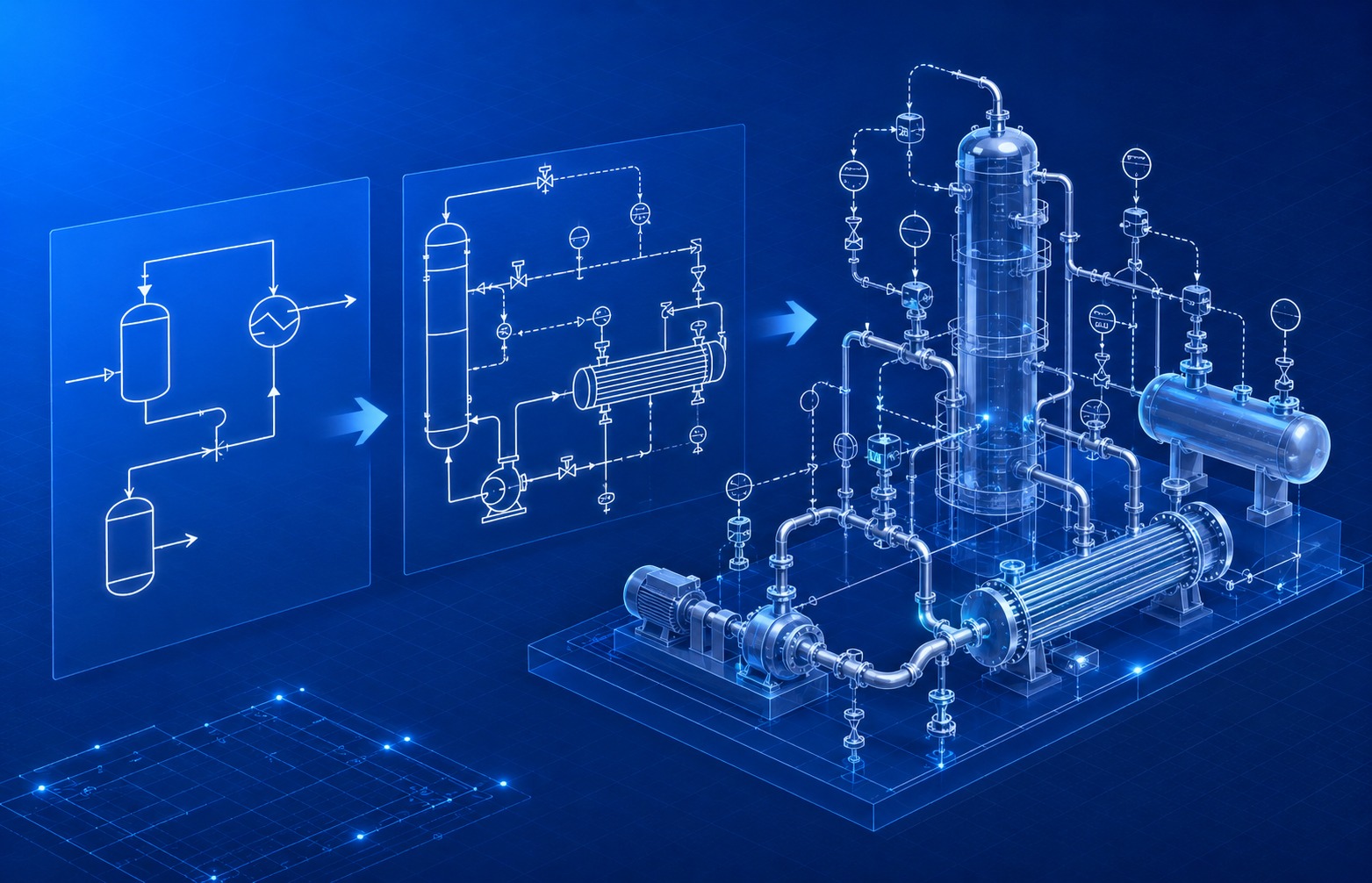
- PFD and P&ID development
- Process simulation using Aspen HYSYS, Aspen Plus and PRO-II
- Mass and energy balances
- Equipment sizing and hydraulic calculations
- Line sizing and fluid-flow analysis
- Relief-system design, PSV sizing and flare-load calculations
- Utility-balance studies
- HAZOP participation and action closure
- SIL-study support
- Process safety reviews and pre-startup safety reviews
- FAT and SAT support
- Energy-optimisation studies
This support can be scaled to complement an EPC or plant owner’s internal team, resolve specific engineering packages or strengthen process capability across a larger programme.
Detailed Engineering Should Begin with Fewer Open Questions
Early process engineering will not eliminate every project change. Feed data may evolve, vendor information will become more detailed and operating requirements may shift.
Its value lies in ensuring that the project enters detailed engineering with the major technical and commercial choices understood.
The strongest process engineering services do not simply advance documents. They reduce the number of expensive decisions that remain unresolved after the project has already committed to a design direction.