


17
April, 2026
Why Manufacturing Aggregator Services Matter for Offshoring Support and Capacity Expansion
Manufacturing expansion is no longer only about identifying more suppliers or opening up more sourcing options. For many manufacturers, the harder challenge is adding capacity without increasing coordination burden, commercial fragmentation, quality risk, and delivery complexity across the supply chain.
That is where manufacturing aggregator services are becoming more important.
A manufacturing aggregator is a distinct engagement model for companies that want offshoring support and additional manufacturing capacity under one contract and single ownership. Instead of asking the client to identify, engage, and manage multiple vendors individually, the model creates a structured operating layer across the wider manufacturing ecosystem. That is what makes it commercially relevant and strategically useful.
What Are Manufacturing Aggregator Services?
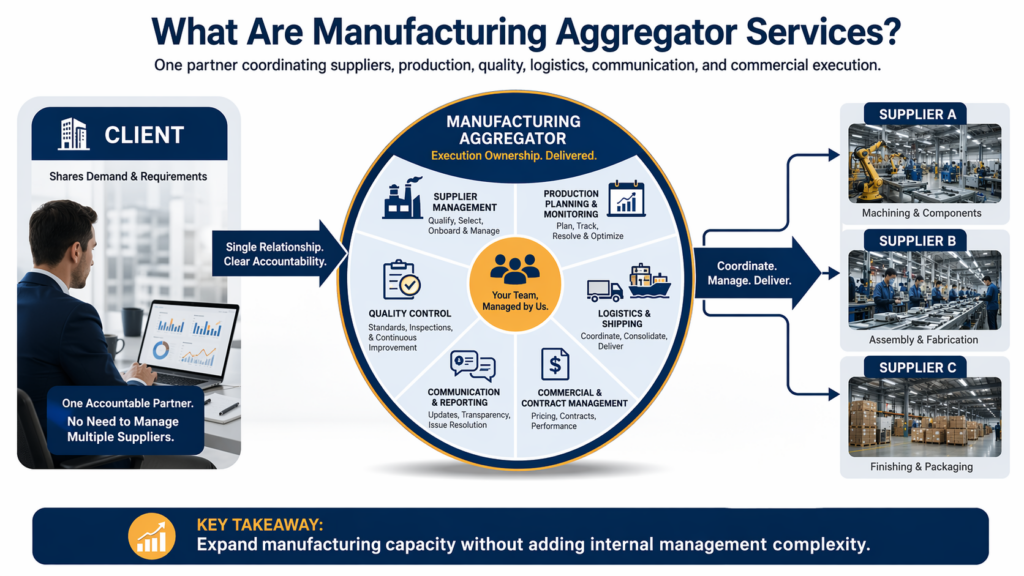
Manufacturing aggregator services are built around execution ownership.
The value is not limited to supplier access. The client needs a dependable way to coordinate suppliers, production, quality, logistics, communication, and commercial execution without building an additional management layer internally. A manufacturing aggregator creates that structure by bringing the wider supply chain under one accountable route of execution.
In practical terms, the model helps the client expand manufacturing capacity without having to manage multiple supplier relationships, separate commercial loops, fragmented production follow-up, and disconnected logistics handling on its own.
How Does a Manufacturing Aggregator Model Support Capacity Expansion?
The manufacturing aggregator model supports capacity expansion by making a broader supply base easier to govern.
In many programs, additional capacity is available, but the operating model around that capacity is weak. Multiple vendors may be capable of executing the work, but once quotations, schedules, inspections, shipment milestones, and documentation start moving through separate channels, the load on the client team rises quickly.
A manufacturing aggregator addresses that by bringing supplier coordination, order flow, production follow-up, quality assurance, and delivery management into one managed framework. That makes it easier to add capacity without creating parallel complexity inside procurement, quality, program, and supply chain functions.
Why Do Manufacturers Need Single Ownership and One Contract?

Single ownership is one of the strongest parts of the manufacturing aggregator model because it improves how execution is controlled.
Without it, the client is often left coordinating:
- separate vendor communication loops
- multiple quotation and commercial discussions
- fragmented production updates
- inconsistent quality follow-up
- disconnected shipment and documentation handling
Even when the supplier base is technically strong, this structure can become inefficient quickly.
A manufacturing aggregator changes that by creating one accountable operating layer across the wider vendor network. The client works through one contract and one ownership structure rather than managing each supplier independently. That improves clarity, shortens escalation paths, and reduces the amount of day-to-day coordination the client has to absorb.
What Does a Manufacturing Aggregator Handle Across the Supply Chain?
A strong manufacturing aggregator model brings together execution functions that are often split across different parties in a conventional setup.
That can include:
- partner network development
- project coordination
- order management
- quality assurance
- production planning and scheduling
- relationship and communication management
- technology integration
- commercial and contract management
- logistics and export coordination
This combination matters because manufacturing performance is shaped not only by who makes the part, but by how well the surrounding execution model is run. Capacity only becomes meaningful when sourcing, planning, inspection, communication, and delivery move with the same discipline.
How Do Manufacturing Aggregator Services Reduce Coordination Effort?
One of the clearest benefits of manufacturing aggregator services is reduced coordination effort for the client.
Instead of having procurement chase multiple quotes, quality teams follow multiple suppliers, and supply chain teams track multiple dispatch schedules, the client gets one managed structure that carries those activities in an organized way. That reduces internal friction and gives the customer a clearer line of ownership across the order lifecycle.
This becomes especially valuable in low-volume, high-mix manufacturing environments, where coordination intensity rises quickly and standard sourcing models often become inefficient.
When Do Manufacturing Aggregator Services Deliver the Most Value?
The manufacturing aggregator model tends to deliver the most value when the client needs broader manufacturing access without broader vendor-management overhead.
Typical situations include:
- offshoring support across multiple work packages
- capacity increase without creating an internal sourcing-heavy structure
- low-volume, high-mix requirements with higher coordination intensity
- programs requiring tighter alignment across quality, delivery, and logistics
- customers who want one accountable partner instead of multiple vendor interfaces
In these cases, the model does more than simplify sourcing. It gives the client a more controlled and scalable route to execution.
How Should Manufacturers Evaluate a Manufacturing Aggregator Partner?
Manufacturers evaluating a manufacturing aggregator partner should look beyond sourcing breadth and focus on operating depth.
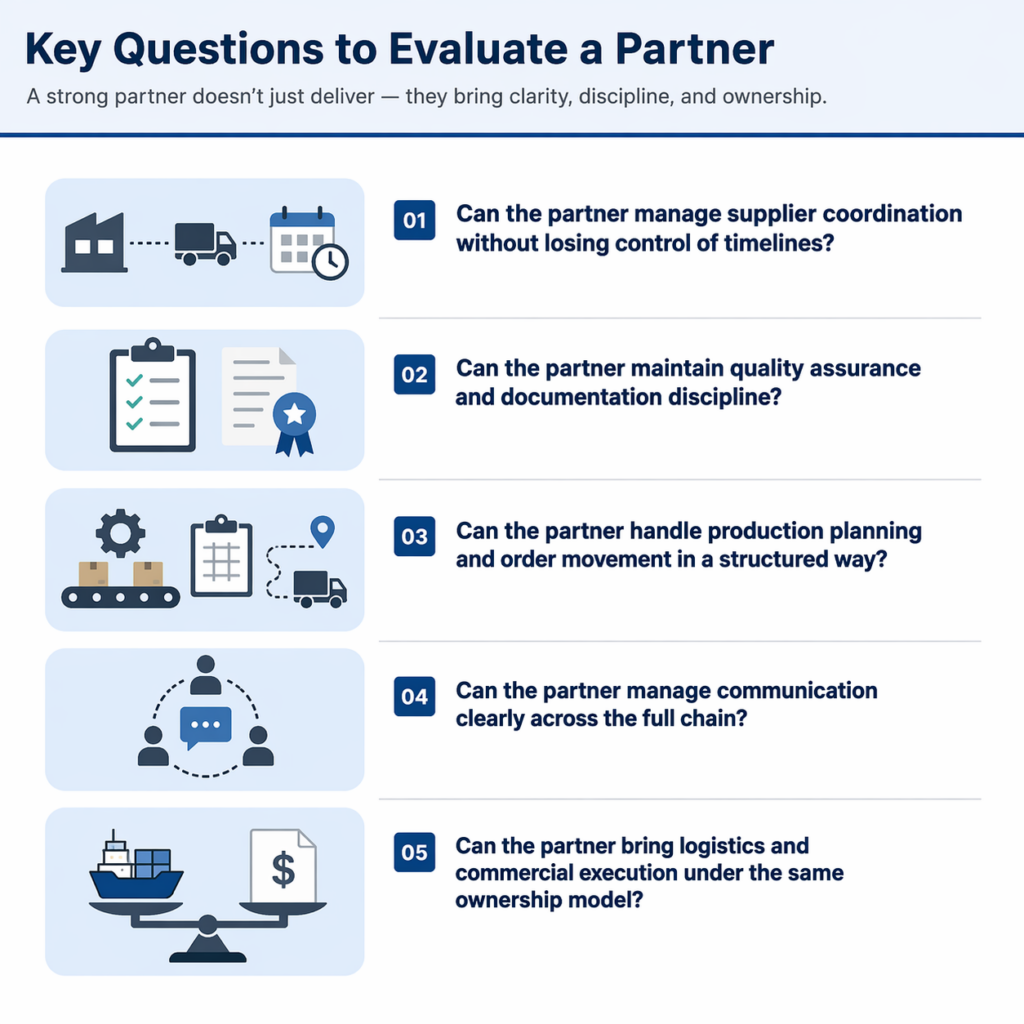
A credible manufacturing aggregator should be able to answer all of those through its operating model, not only through marketing language.
Closing View
Manufacturing aggregator services are gaining importance because manufacturers want scalable capacity models without the management burden of handling multiple vendors individually.
That is the real value of the model.
It is about creating a more structured path for offshoring support and capacity expansion through one contract, single ownership, and a controlled execution framework across the wider supply chain. Positioned that way, manufacturing aggregator becomes a strong proposition for manufacturers looking to scale with greater confidence.