

12
May, 2026
High-Density Data Centers: When to Shift from Air Cooling to Liquid Cooling
For years, data center cooling design followed a predictable path CRAC with raised floor tile with either HAC or CAC were enough for rack cooling. But AI, HPC, and high-density racks are defining new rules. We’ve hit the thermal ceiling. Here’s how to know when air cooling is failing and why liquid cooling is the only way forward. That playbook still works for a large part of the market till the recent past. But it is now being pushed hard by high-performance computing (HPC), artificial intelligence (AI) training clusters, GPU-heavy inference, and dense accelerated servers.
The question for owners, colocation providers, hyperscalers, and engineering teams is no longer whether air cooling is “good” or “bad.” The real question is more practical: at what rack density does air cooling stop being the right engineering decision?
That point is getting closer for many facilities in the USA and Europe. The International Energy Agency projects global data center electricity consumption to double to around 945 TWh by 2030, with accelerated servers becoming one of the strongest contributors to demand growth. The USA, China, and Europe are expected to remain the largest regions for data center electricity demand, with Europe’s demand projected to grow by more than 45 TWh by 2030.
Why Rack Density Has Changed the Cooling Conversation
A traditional enterprise rack may sit around 5 to 15 kW. Many modern cloud and compute deployments have moved well beyond that. AI and HPC environments are now forcing design teams to evaluate 40 kW, 50 kW, 70 kW, and in some cases even higher densities per rack.
NVIDIA’s GB200 NVL72 is a useful marker of where the market is heading. It connects 36 Grace CPUs and 72 Blackwell GPUs in a rack-scale, liquid-cooled design. NVIDIA describes it as an exascale computer in a single rack. Uptime Institute notes that the NVL72 system is rated at around 132 kW in a rack, with cold plates handling around 100 kW of thermal power and air exhaust exceeding 25 kW at full system load.
That does not mean every data center will run 100 kW racks. It does mean the facility design envelope has changed. Power distribution, floor loading, pipe routing, water treatment, leak detection, redundancy, and service access now need to be assessed much earlier in the project lifecycle.
When Does Air Cooling Become Insufficient?
There is no single universal cut-off because the answer depends on server architecture, airflow path, room conditions, redundancy philosophy, climate, chilled water strategy, and whether rear-door heat exchangers are used.
Air cooling is traditional and simple, but it’s also inefficient. Once rack densities exceed 30–40kW, air cooling becomes a losing battle. You end up with screaming fans, thermal hotspots, and PUEs going above 1.5. At a certain point, moving more air just doesn’t move enough heat. With same Data Hall space and high IT loads, it is impossible to plan air cooling with CRAH or Fan wall units with 100% air cooling. Air cooling is generally designed for 160 cfm /kw based on temperature difference of 11 °C across IT racks. Conventionally, Data Hall load would be 4 MW with IT Rack having 4.5 Kw load each. With 160 cfm/kw load, these Data Hall would need 6,40,000 CFM for cooling. Now with advent of AI, the same space serves 27.5 MW to 40 MW and may be more in future. If we now, try to design the data hall cooling for 27.5 MW IT load with only air then we would need 44,00,000 CFM. This would be impossible to plan the CRAC /Fan wall units in the given space for this capacity of Air flow. Here the liquid cooling comes into play where 70 % load is served by Liquid to chip cooling with help of CDUs while the rest 30 % load is served by Air cooling resulting only 13,20,000 CFM Air flow requirement.
Still, a practical engineering view looks like this:
| Rack Density | Typical Cooling Direction | Engineering View |
| Up to 15 to 20 kW/rack | Optimized air cooling | Usually manageable with good containment, (HAC OR CAC) airflow discipline, and cooling capacity planning |
| 20 to 40 kW/rack | Advanced air or hybrid cooling | Air cooling may still work, but fan energy, airflow volume, and hot spot risk rise sharply |
| 40 to 50 kW/rack | Hybrid cooling becomes serious | Rear-door heat exchangers, in-row cooling, or liquid-assisted strategies often become necessary |
| Above 50 kW/rack | Liquid cooling is typically evaluated | Uptime Institute notes that for high rack power above 50 kW, liquid cooling is typically employed |
| 70 kW/rack and above | Direct liquid cooling or hybrid liquid-air | Air alone becomes difficult to justify from reliability, airflow, energy, and space standpoint |
Uptime Institute’s AI guidance says perimeter cooling remains common for traditional low-density workloads, while high rack power above 50 kW or specialized high-performance IT typically uses liquid cooling. In another analysis, Uptime notes that spreading GPU nodes can reduce sustained rack power to under 50 kW, where air cooling can remain technically viable with strong airflow management, containment, in-row coolers, or rear-door systems. However, fan power may account for up to 10% of full load in that scenario.
That is the key point. Air cooling may still be possible at some high densities, but possible does not always mean efficient, resilient, scalable, or future-ready.
The Real Triggers for Moving to Liquid Cooling
The shift to liquid cooling should not be based only on a kW-per-rack number. It should be triggered by a combined assessment of thermal, electrical, operational, and commercial factors.
1. Airflow Volume Becomes Impractical
At higher rack densities, the amount of air required to remove heat becomes difficult to move, control, and return without recirculation. Above example of 27.5 MW of Data Hall clearly describes the limitation with Air cooling. Even well-designed containment can struggle when racks discharge extremely high thermal loads into limited white space.
When airflow rates increase, fan power rises, static pressure management becomes harder, and local hot spots become more likely. At this stage, the facility may still “cool” the load, but with reduced operating margin.
2. GPU Performance is at Risk
AI and HPC workloads are sensitive to sustained thermal stability. If chips run hot, performance throttling can reduce the benefit of expensive accelerated hardware. Direct-to-chip liquid cooling removes heat closer to the source using cold plates attached to processors or other critical components. This improves heat transfer compared with relying only on server fans and room-level air movement.
3. White Space Capacity Becomes Constrained
A facility may have enough total cooling capacity on paper yet still fail at rack level because of localized load concentration. Liquid cooling helps raise compute density without simply adding more racks, more floor area, and more airflow hardware.
This matters in land-constrained European markets and in major US data center regions where grid connection, permitting, and expansion timelines are already under pressure.
4. Energy and Water Reporting Pressure Increases
Cooling strategy is becoming a sustainability and compliance decision. The European Commission has introduced data center energy performance monitoring and reporting obligations under the Energy Efficiency Directive. The reporting framework includes energy performance and water footprint indicators for data centers with significant energy consumption.
For European operators, cooling choices now connect directly to Power Usage Effectiveness (PUE), Water Usage Effectiveness (WUE), heat reuse potential, and regulatory reporting. For US operators, the Department of Energy notes that data center electricity demand is growing rapidly, varies regionally, can affect local grids, and often requires firm power for continuous operation.
Water has 4x the heat capacity of air and conducts heat exponentially better. Direct-to-chip cooling (cold plates on CPUs/GPUs) removes 70-80% of heat right at the source. The result: lower fan power, higher chip performance (no thermal throttling), and PUEs as low as 1.15 to 1.2.
Which Liquid Cooling Model Fits Best?
Liquid cooling is not one design. The correct model depends on the workload and the facility.
Rear-door heat exchangers are often a practical first step for high-density racks because the liquid loop captures heat from server exhaust before it enters the room. They help extend air-cooled server deployments without immediately redesigning every rack around direct-to-chip cooling.
Direct-to-chip cooling uses cold plates on processors, GPUs, or other high-heat components. It is becoming a preferred option for AI and HPC because it targets the main heat sources while keeping some air cooling for memory, power supplies, storage, and ancillary electronics.
Immersion cooling can support very high heat densities, but it changes maintenance workflows, hardware compatibility, fluid management, safety procedures, and service models. It is better evaluated as a strategic architecture choice rather than a simple replacement for air cooling.
In many AI-ready data centers, the near-term answer is hybrid cooling. A liquid loop handles the most intense chip-level heat, while air cooling continues to manage residual loads, networking equipment, power electronics, and room environmental control. A 2025 review in Sustainable Energy Technologies and Assessments notes that commercially mature approaches include rear-door heat exchangers and cold plate direct liquid cooling, with hybrid systems becoming important for AI-ready cooling strategies.
Many Designs Underestimate Operational Considerations
Liquid cooling is a mechanical system inside a digital business. That means reliability depends on more than cooling capacity.
Water quality is one of the most important design and operations issues. ASHRAE’s water-cooled server guidance highlights that coolant distribution units (CDUs) provide key functions such as condensation prevention, water quality isolation, flexible coolant selection, flexible coolant temperature, and reduced operating pressure for IT equipment.
Filtration and material compatibility are also critical. ASHRAE notes that corrosion, scaling, fouling, and microbial issues can affect technology cooling system loops, and that applying the wrong water quality requirement to the wrong loop can create serious risk. For non-CDU implementations, the guidance also stresses filtration planning because cold plate flow paths can be narrow and vulnerable to particulate build-up.
Redundancy also needs careful thought. A liquid-cooled AI hall cannot treat pumps, CDUs, controls, valves, sensors, leak detection, and isolation points as secondary details. The cooling topology should align with the required availability level. Maintenance strategy must allow sections to be isolated, serviced, flushed, tested, and recommissioned without creating unacceptable downtime risk.
TAAL Tech: Cooling Strategy Needs Design Intelligence Early
For high-density data centers, the cooling decision should not wait until equipment selection is complete. By then, many constraints are already locked in: rack layout, power routes, ceiling and floor clearances, maintenance corridors, pipe pathways, plantroom provisions, and structural allowances.
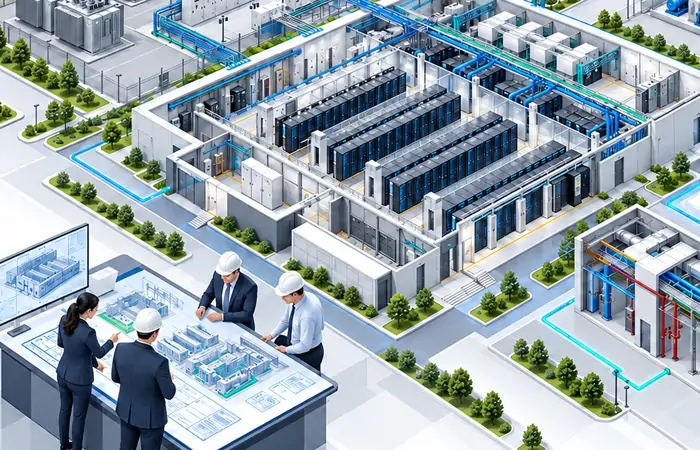
TAAL Tech’s design support approach helps clients evaluate these decisions earlier through BIM-driven load modeling, equipment clearance checks, coordinated piping layouts, and CFD-linked analysis-ready models. This allows project teams to test different density scenarios before they turn into expensive redesigns.
For example, a 30-kW rack zone may appear manageable with optimized air cooling. But if the client roadmap includes 50 kW or 70 kW AI racks within the next few refresh cycles, the design should account for liquid-ready piping routes, CDU locations, service access, leak containment zones, and future cooling distribution. Similarly, a brownfield facility may not need full liquid cooling across the hall, but it may need a carefully phased hybrid model for selected AI pods.
This is where engineering coordination becomes valuable. BIM can help validate equipment clearances, maintainability, valve access, pipe clashes, and modular expansion space. CFD-linked models can help identify recirculation, hot spots, containment gaps, and airflow interaction with liquid-assisted systems. Coordinated MEP layouts can reduce the risk of late-stage routing conflicts between chilled water, technology cooling loops, busways, cable trays, fire systems, and access zones.
The Best Time to Decide Is Before the Rack Arrives
Air cooling will continue to serve a large share of data center workloads. But for AI and HPC environments moving toward 40 to 70 kW per rack, the design conversation must change.
The shift to liquid cooling is justified when airflow becomes operationally inefficient, when chip-level thermal stability affects performance, when rack density limits future expansion, or when sustainability and reporting requirements demand a better cooling architecture.
The strongest facilities will not be the ones that simply choose air or liquid. They will be the ones that model the load properly, design for hybrid realities, preserve maintenance access, manage water quality, and build enough flexibility for the next generation of accelerated hardware.
For data center owners, colocation providers, and engineering teams in the USA and Europe, that is the real cooling challenge now: not only removing today’s heat but designing a facility that can absorb tomorrow’s density without starting again.